

Tom Willis is an award-winning marketing leader and Co-founder of Lawpath. Tom’s journey journey includes steering several entrepreneurial projects and addressing the unique challenges faced by small businesses. As the Chief Marketing Officer at Lawpath, Tom has been pivotal in shaping the company’s marketing strategy and business growth.
More than 107,587 new businesses were registered in Australia in January 2026. At a glance, that signals a confident start to the year for entrepreneurship. Look deeper, and the figures reveal something more nuanced about how Australians are launching ventures, the structures they are selecting, and what this means for the competitive environment in 2026. From sole traders getting their first ABN to founders choosing to register a company from day one, the January data tells a story of deliberate, structured entry into market.
The January 2026 Lawpath Business Index combines official data from the Australian Business Register and ASIC with de identified insights from thousands of businesses formed through the Lawpath platform. Together, this creates a real time snapshot of entrepreneurial behaviour across the country.
This month, the defining theme is commitment. Founders are not only entering the market in large numbers, they are making deliberate structural and tax decisions earlier in their journey. The data suggests a shift from informal experimentation toward structured commercial intent.
For business owners already operating, these movements are significant. They shape market density, influence pricing dynamics, affect talent supply, and determine how quickly new competitors mature. Below is a breakdown of what the January numbers are really telling us.
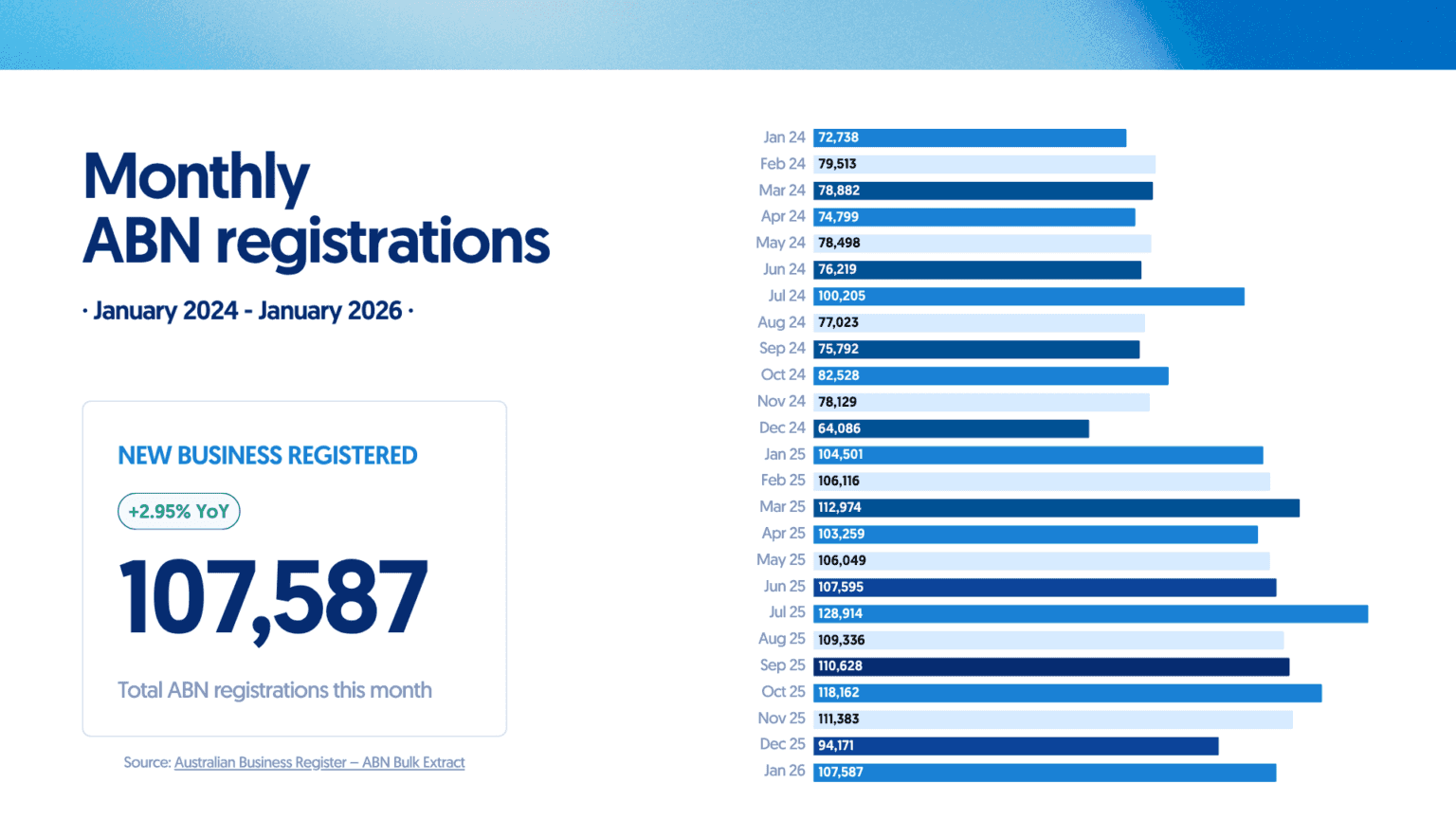
Monthly ABN Registrations
The most immediate indicator is the level of new ABN activity.
In January 2026, 107,587 ABNs were issued, marking a 2.9% percent increase compared to the same month last year. While growth YoY was slower it is still the strongest January result on record.
This does not equate to over one hundred thousand fully operational enterprises competing at scale. Rather, it reflects how quickly Australians are formalising income streams. Consultants, trades, digital sellers, contractors, and side ventures are choosing to establish legitimacy at the outset instead of waiting, whether that means registering an ABN as a sole trader or registering a company for greater asset protection from day one.
The barrier to entry remains low, and more individuals are taking advantage of that accessibility.
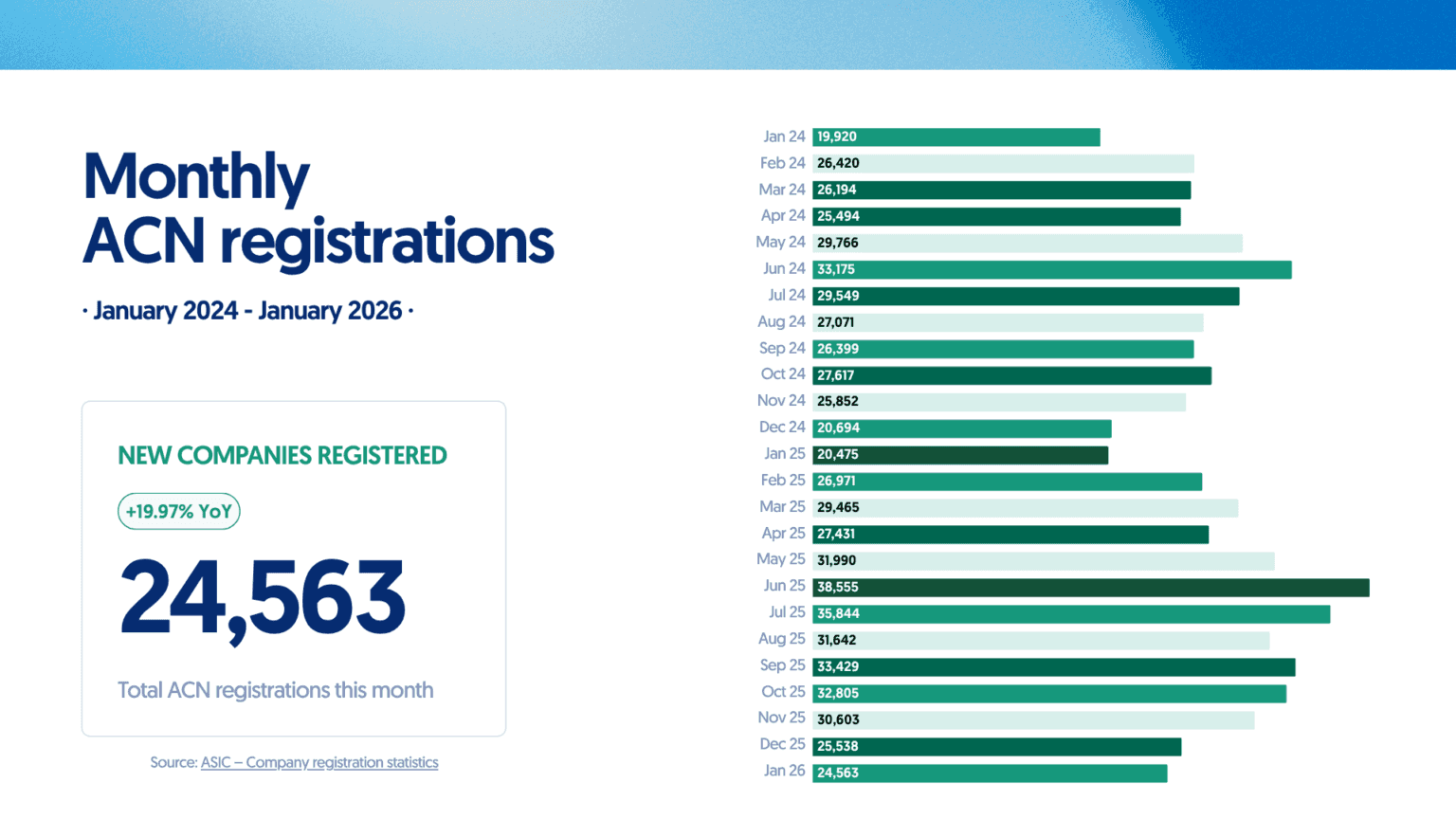
Monthly ACN Registrations
Company formations provide a second layer of insight.
January saw 24,563 new companies registered, representing 19.97% percent growth from the previous month high in January 2025.
This indicates that a considerable segment of founders are prioritising asset protection, governance clarity, and long term scalability from day one.
For established operators, this suggests a portion of new entrants are preparing for sustained activity rather than short term experimentation.
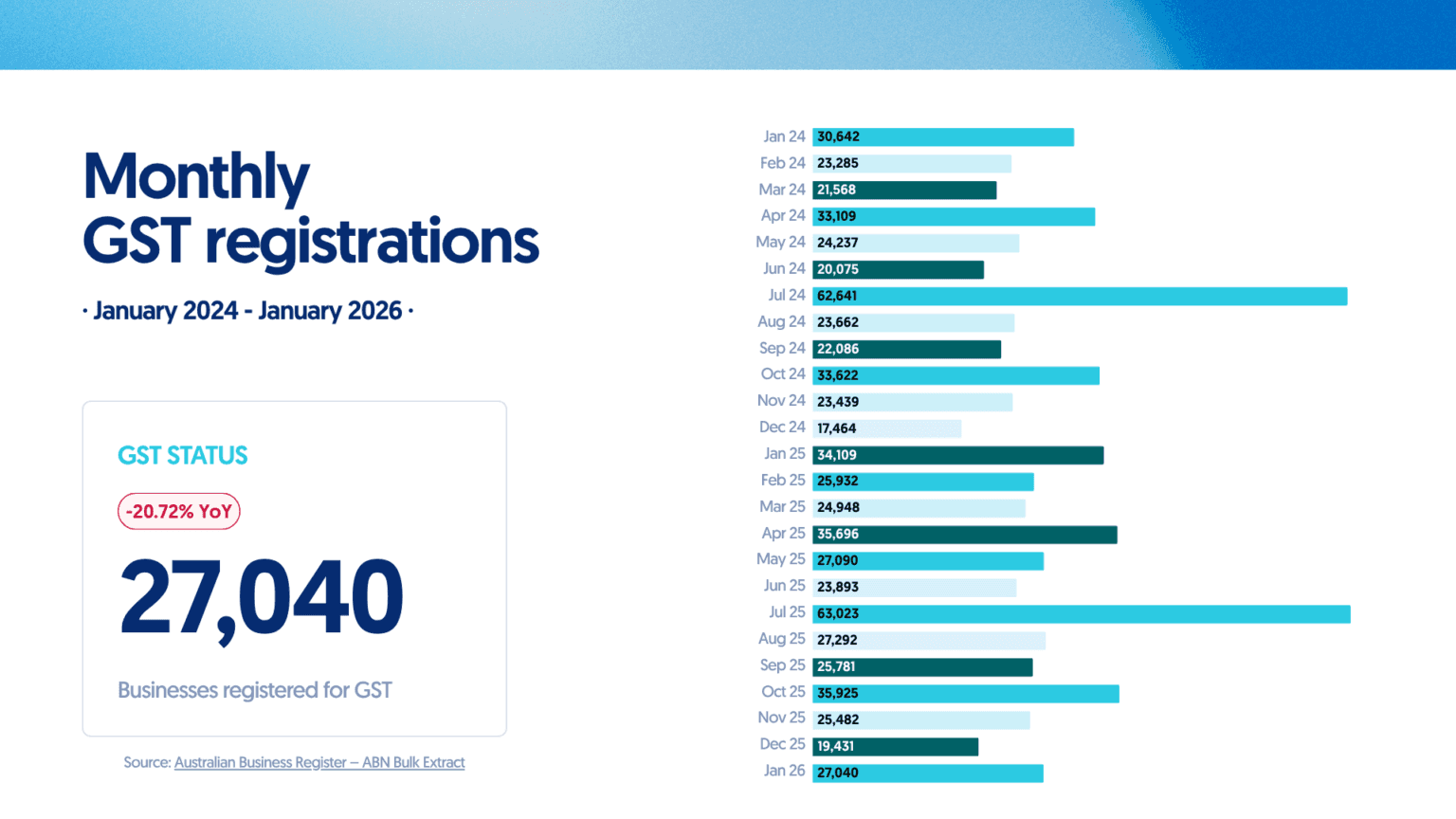
Monthly GST Registrations
Tax registration behavior further clarifies the picture. In January 2026, 27,040 businesses registered for GST, a drop of 20.72% year-on-year.
The widening gap between ABN growth and GST decline reveals a cautious approach. Many new businesses are either trading below the $75,000 GST threshold or testing concepts before committing to tax obligations.
This suggests founders are prioritising flexibility and lower compliance burdens in the early stages, potentially delaying formalization until revenue streams are validated.
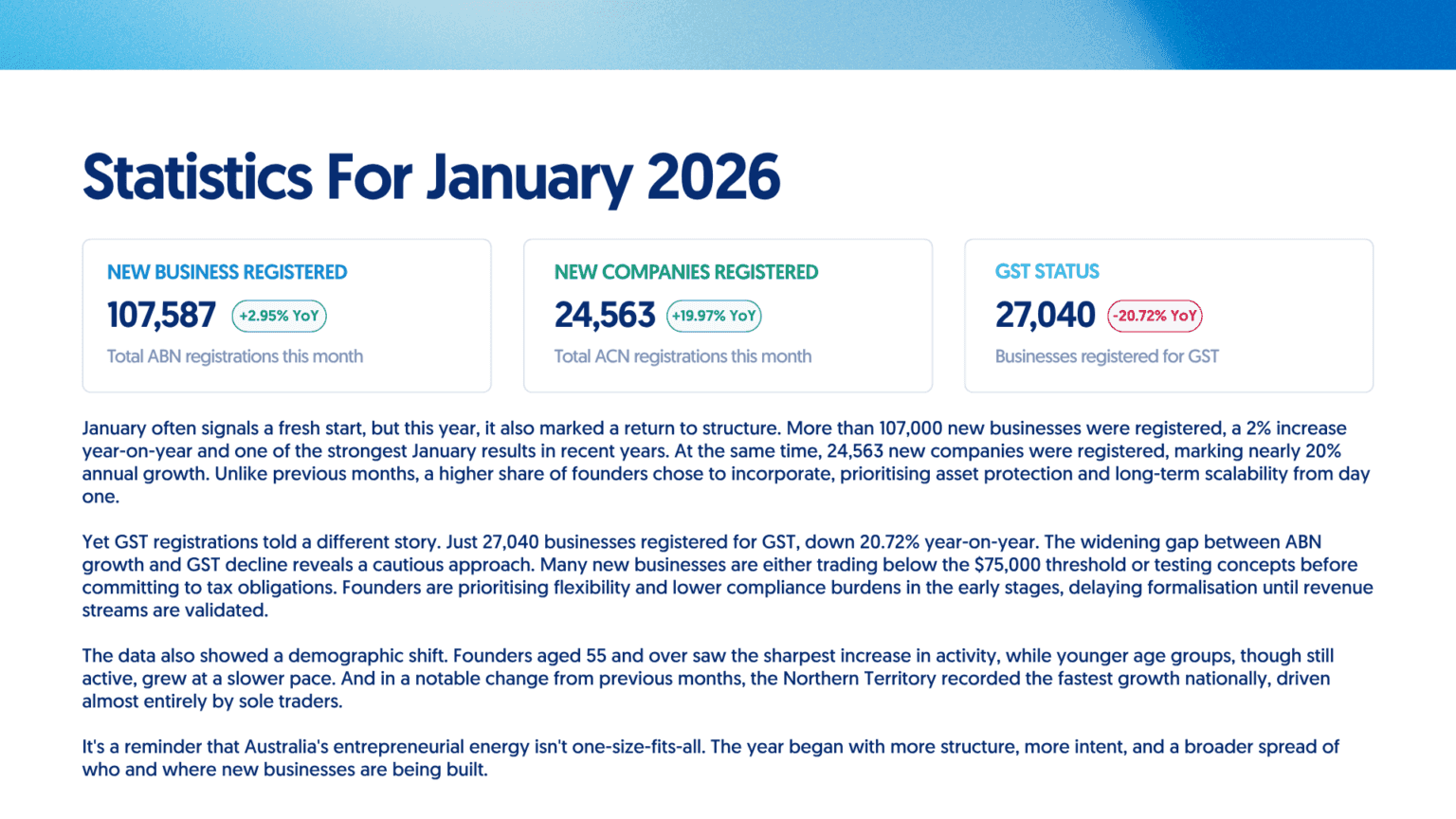
Statistics for January 2026
When viewed collectively, the January data highlights a behavioral pattern.
ABN registrations kept steady. Company formations growth continued to build momentum. GST registrations declined significantly.
This combination reflects two simultaneous motivations. First, Australians continue to use business ownership as a mechanism for flexibility and income diversification. Second, a growing portion are building structured entities with compliance and scalability in mind – although the drop in GST registrations suggests many are testing concepts before committing to tax obligations.
Against a backdrop of persistent cost pressures and cautious consumer spending, entrepreneurship remains both a defensive and strategic move.
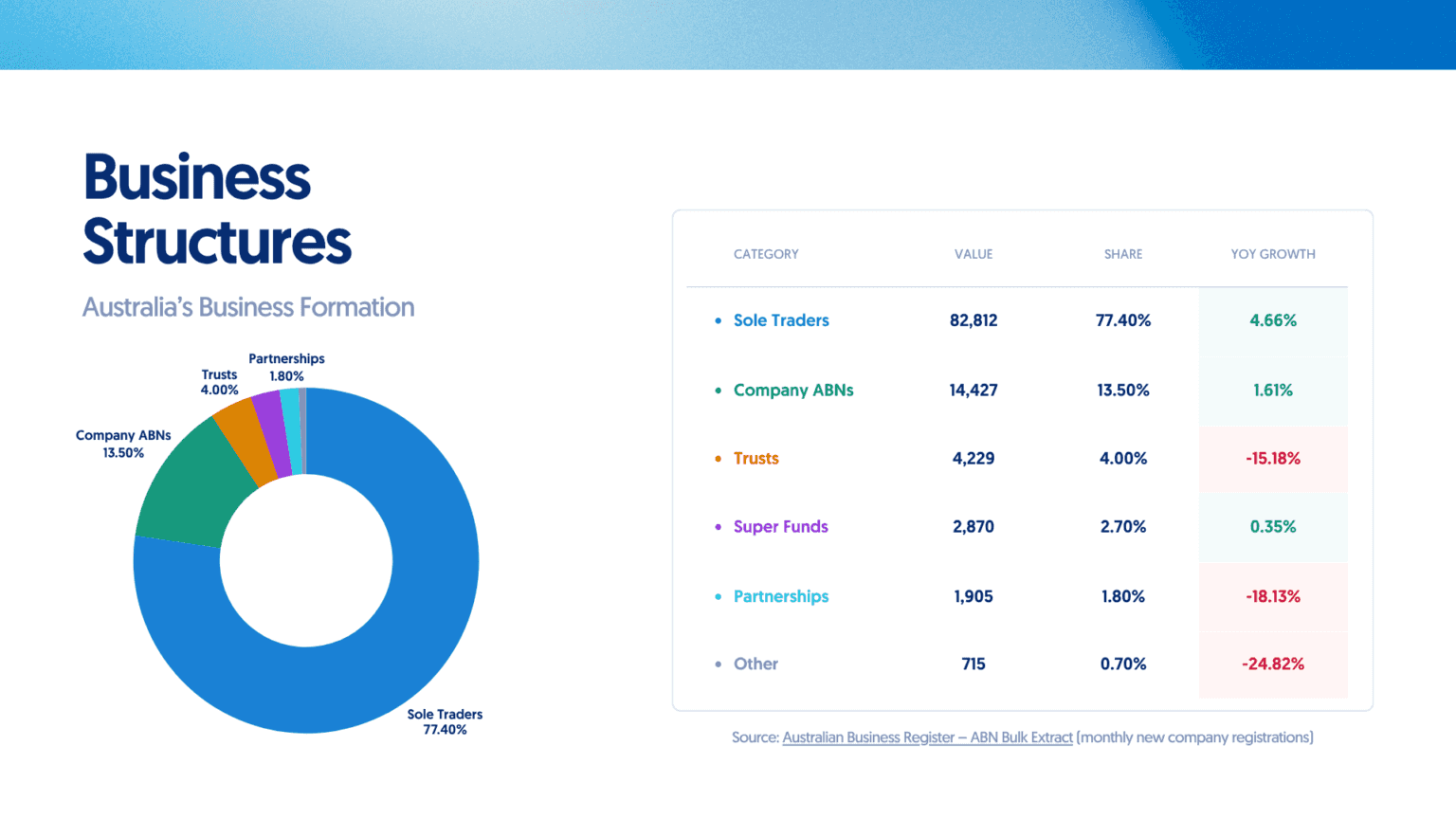
Business Structures
Structure selection reveals a growing separation between entity formation and business activation.
Sole traders continue to account for the majority of new ABNs, representing 77.4% of all registrations. This reflects their role as the default structure for individuals beginning to trade. The appeal remains clear: rapid setup, minimal compliance requirements, and full operational control. Growth in this segment remained steady at +4.66% YoY, indicating consistent entry-level business formation.
However, company behaviour tells a more nuanced story. While new company registrations (ACNs) increased approximately 19% YoY, company ABNs rose only 1.61% YoY, and total ABNs increased just 2.9%. This divergence suggests that companies are increasingly being established as legal structures, but not all are being immediately activated as trading entities.
Several structural dynamics likely explain this shift:
- Earlier incorporation, delayed activation: Founders are securing corporate structures earlier in the lifecycle, while delaying operational commencement until revenue, funding, or market conditions justify activation.
- Growth in non-trading corporate entities: Holding companies, corporate trustees, and investment vehicles often require an ACN but do not immediately require an ABN, contributing to company formation growth without a corresponding increase in trading registrations.
- Structural preparedness for scale: Founders building digital, AI-enabled, or scalable businesses are incorporating earlier to enable investment, equity allocation, and asset protection, even before commencing trading. If you are weighing up whether to incorporate now, our guide to setting up a company in Australia covers the key benefits and timing considerations.
- Optionality in uncertain conditions: Incorporation provides founders with flexibility to move quickly when opportunities arise, without committing immediately to trading obligations.
It remains too early to determine which of these forces will dominate. If these companies convert into active trading entities over the coming months, this may signal a pipeline of future business activity. If not, it may reflect a structural increase in dormant, preparatory, or investment-oriented entities. Subsequent data on ABN activation and trading activity will provide greater clarity.
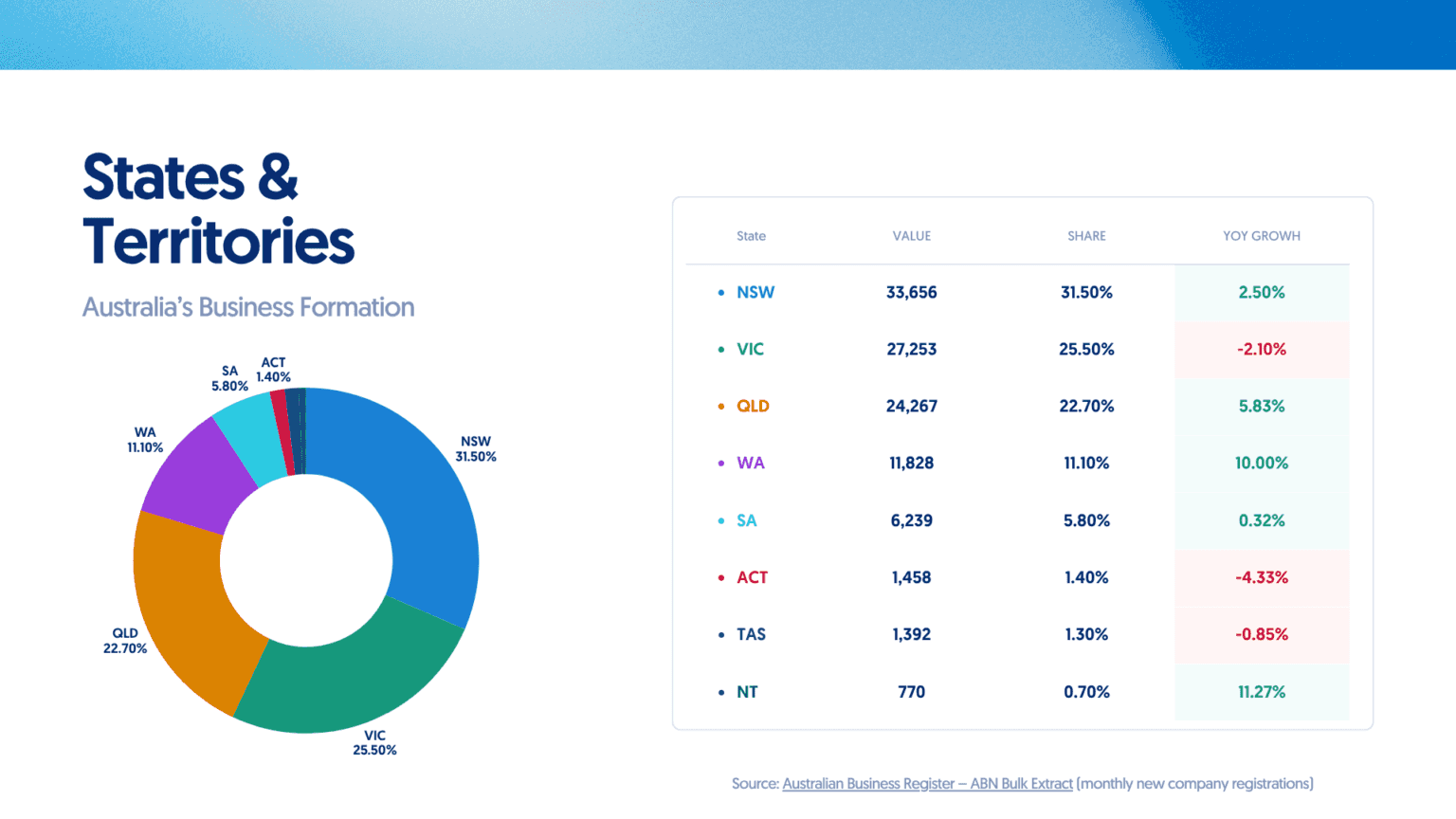
States and Territories
Entrepreneurial activity in January is not isolated to one region.
New South Wales, Victoria, and Queensland contribute the largest absolute numbers due to population size. However, growth across Western Australia, South Australia, and the Northern Territory indicates widespread participation.
Migration patterns, housing affordability, and the continued viability of remote enabled work are dispersing business creation beyond historic commercial hubs.
For current operators, opportunity and competition are increasingly decentralised.
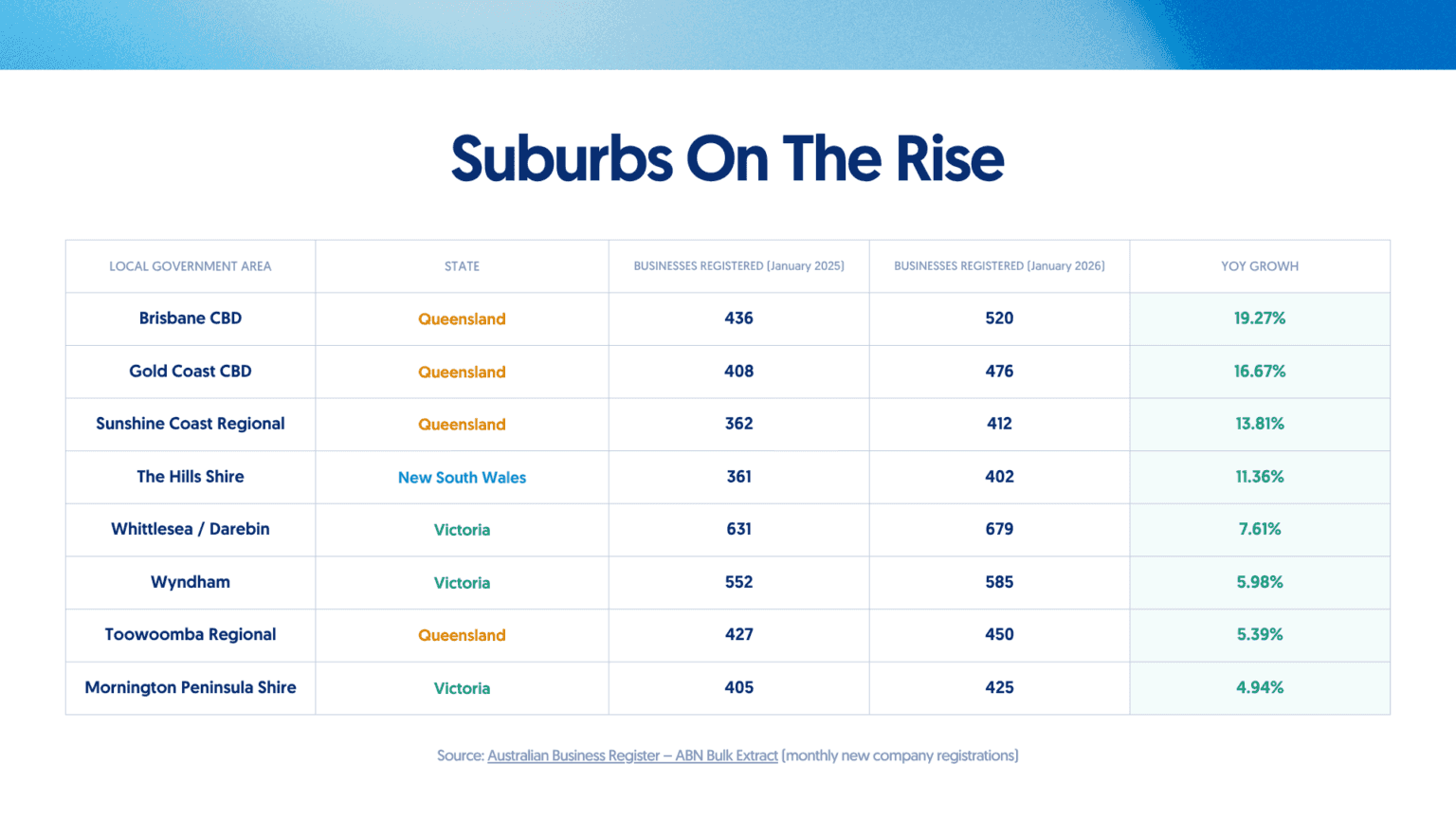
Top Suburbs by New Business Registrations
Major CBDs such as Melbourne, Sydney, and Brisbane continue to record high volumes of new registrations.
These locations benefit from infrastructure, professional ecosystems, and network density. However, high volume does not always equate to highest growth.
Outer metropolitan corridors are contributing significant numbers as population expansion fuels localised demand. Many new ventures are being established from home offices rather than traditional commercial premises.
Suburbs Experiencing Rapid Growth
Some of the strongest percentage increases are occurring in suburban and peri urban areas.
Locations across Western Australia, Queensland, South Australia, and outer Victoria are showing accelerated growth, driven by affordability and expanding communities.
For established businesses, these regions may represent emerging customer bases that are still under serviced.
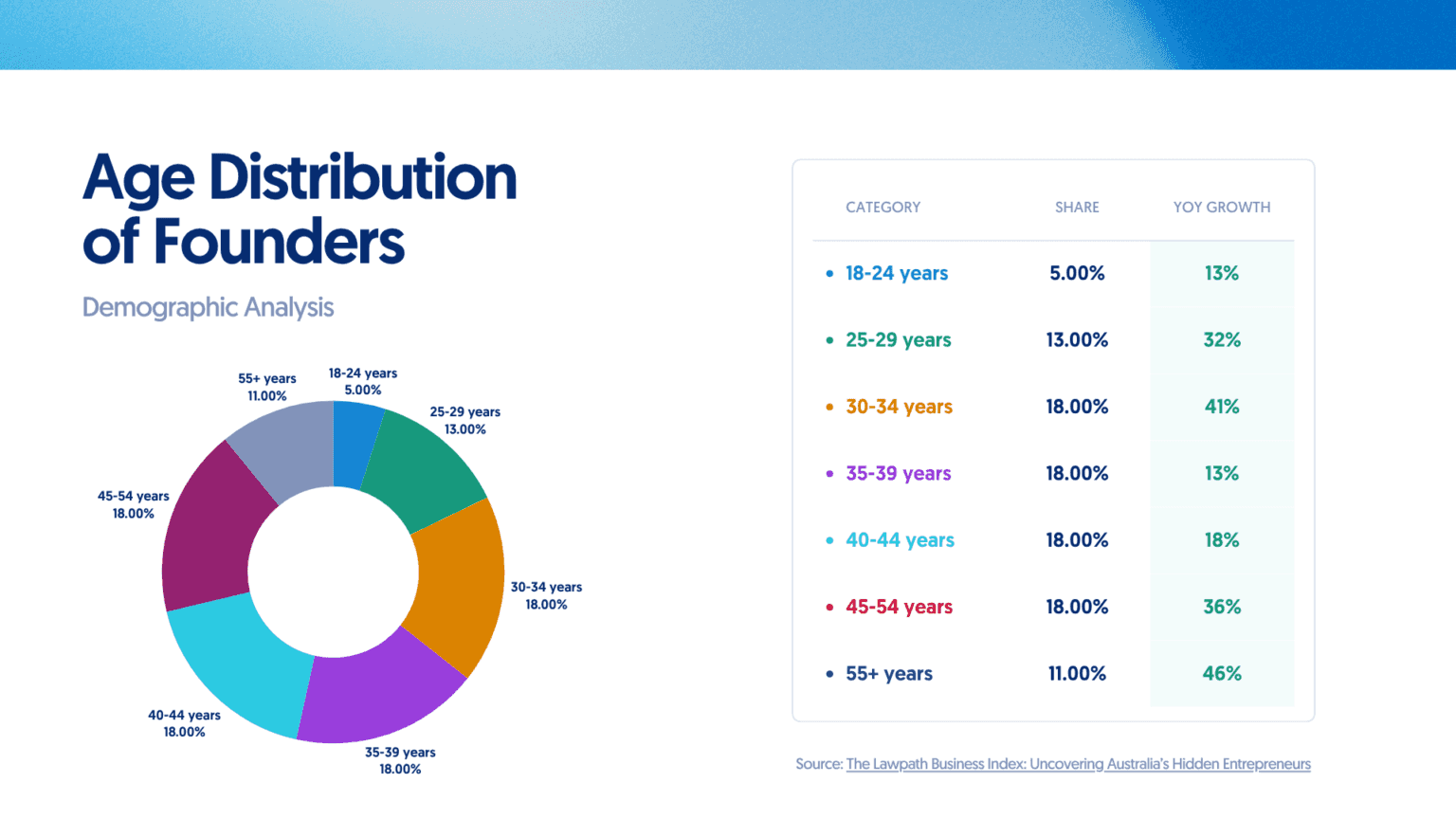
Age Distribution of Founders
Entrepreneurship continues to span generations.
Individuals aged 35 to 54 represent the largest group of founders, typically bringing industry experience and established networks.
Younger founders are also increasingly visible. Early entry into business is becoming a parallel pathway alongside employment, enabled by digital platforms and lower startup costs.
This demographic mix influences innovation cycles, digital adoption, and expectations around flexibility and autonomy.
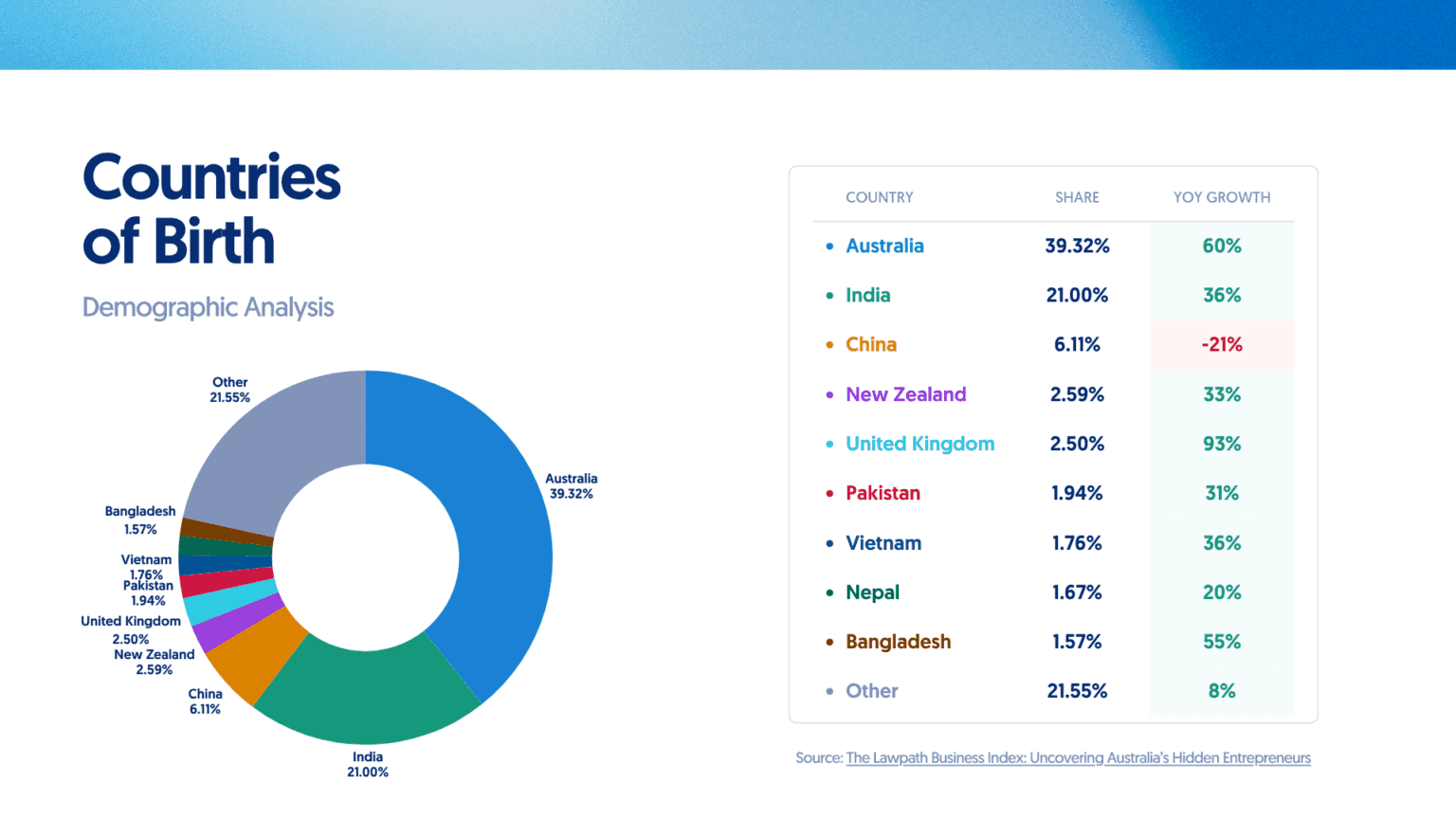
Countries of Birth
Australia’s entrepreneurial landscape remains highly diverse.
While Australian born founders represent a significant proportion, a substantial share of new registrations come from migrants and first generation Australians.
Growth is broadly distributed across many countries of origin. For business owners, this reinforces the need to understand culturally diverse markets and consumer behaviours.
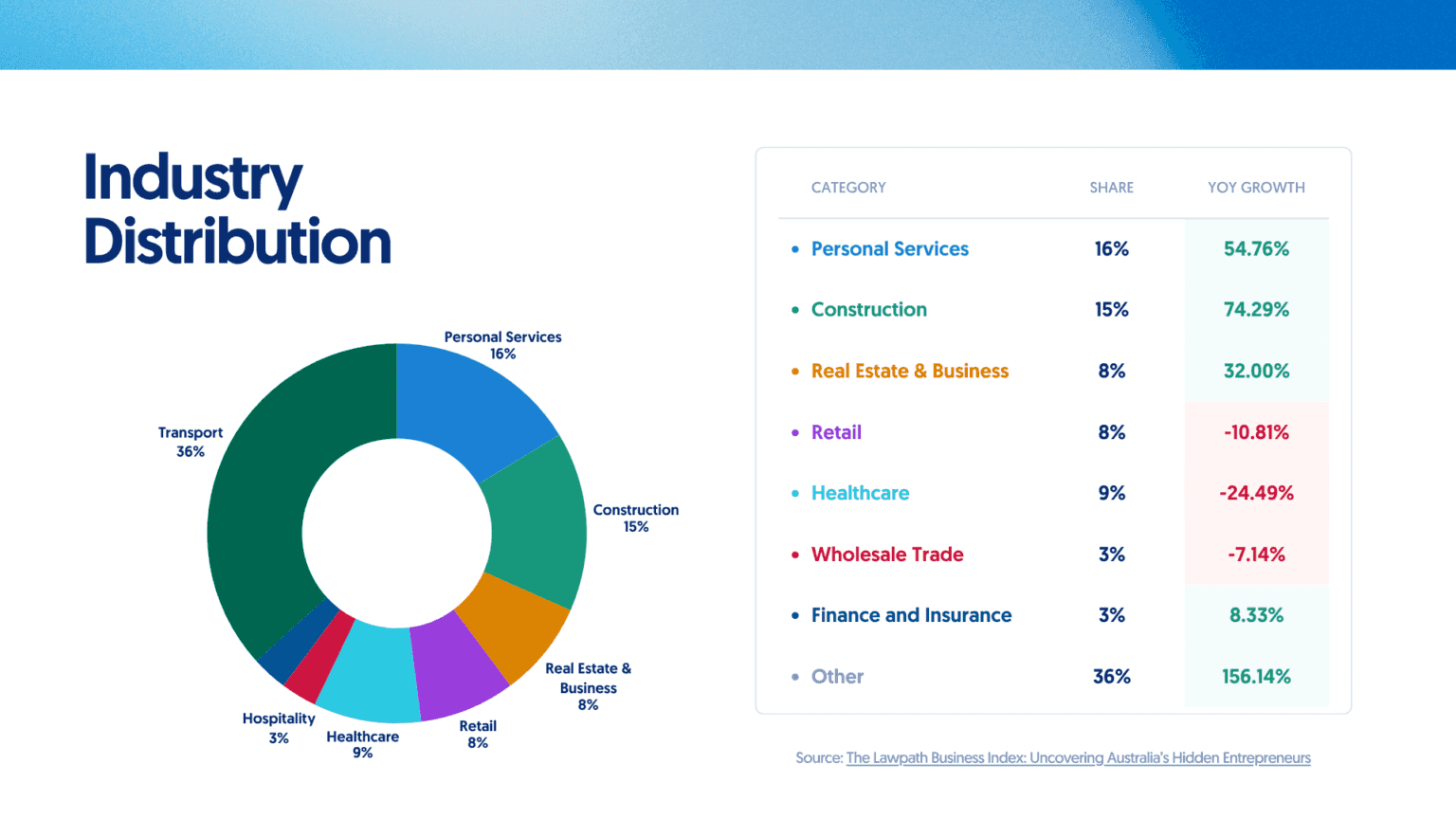
Industry Distribution
January’s industry breakdown highlights demand driven sectors.
Personal services continue to feature prominently, alongside construction related trades, professional services, property activities, transport, and online commerce.
These are not speculative trends but responses to tangible economic needs. Businesses operating within or adjacent to these sectors are likely to experience increased competitive activity. If you are entering any of these markets, our guide to how to start a business in Australia outlines the legal steps to set up properly from day one.
Why this matters for business owners
The January 2026 Lawpath Business Index demonstrates that entrepreneurship in Australia remains robust, structured, and increasingly intentional.
The competitive landscape is being shaped by earlier market entry, more formalised entities, and faster progression from idea to registered operation.
For existing businesses, understanding these patterns is critical for strategic positioning, pricing decisions, workforce planning, and identifying growth corridors.
The Lawpath Business Index will continue to monitor these developments each month, providing ongoing clarity about how Australian business is evolving in real time.