
Chartered Accountant Timothy Quinn leads Tax & Accounting at Lawpath. 16+ years in tax advisory, specialising in startup growth and expansion. Passionate about supporting entrepreneurial clients with early-stage investment incentives, restructuring, international exit strategy planning, and more.
💡 Key Insight
- Australian tax laws for businesses cover more than income tax and commonly include GST, PAYG, Fringe Benefits Tax, and state taxes, with obligations varying based on business structure, turnover, and whether staff are employed.
- A common mistake under Australian tax law is assuming all expenses are deductible, when only costs directly related to earning assessable income qualify, making accurate record-keeping and separation of personal and business finances essential.
- GST and PAYG obligations require ongoing reporting through BAS and payroll systems, meaning tax compliance in Australia is continuous rather than a once-a-year task for most businesses.
- Effective tax planning in Australia goes beyond lodgement by proactively structuring income, deductions, and business growth decisions to improve cash flow, reduce risk, and avoid unexpected ATO liabilities.
Feeling overwhelmed by the various tax laws in Australia? Between multiple tax types, changing laws, and shifting reporting obligations, it’s easy to feel unsure where to start.
This article provides a practical overview of how Australian tax laws work, your obligations, and common pitfalls to avoid. We’ll cover the key areas most businesses encounter: income tax, GST, PAYG, Fringe Benefits Tax (FBT), key state taxes, and filing obligations.
Let’s get started.
Table of Contents
The main tax laws in Australia: An overview
Australia’s taxation landscape is broad. The taxes your business must pay depend largely on your business structure, turnover, and whether you employ staff. While many think of taxation solely in terms of income tax, most businesses face several obligations simultaneously.
At a high level, the main tax types include:
| Tax Type | Administered By | Who Pays / Applies To | Key Purpose | Typical Frequency |
| Income Tax (for individuals, companies, and trusts) | Australian Taxation Office (ATO) | All income-earning individuals, businesses, and entities | Tax on net profit or taxable income earned during the financial year | Annually (usually 1 July–30 June cycle) |
| Goods and Services Tax (GST) | ATO | Businesses with annual turnover ≥ $75,000 ($150,000 for non-profits) | 10% tax on most goods and services supplied in Australia | Quarterly or monthly (via BAS) |
| Pay As You Go Withholding (PAYGW) | ATO | Employers | Withholding income tax on behalf of employees | Varies (monthly, quarterly, or annually) |
| Pay As You Go Instalments (PAYGI) | ATO | Employers and businesses who paid income tax in their last annual income tax return | Progressive payment of expected income tax throughout the year | Varies (monthly, quarterly, or annually) |
| Fringe Benefits Tax (FBT) | ATO | Employers providing non-cash benefits to employees | Tax on benefits such as cars, entertainment, and accommodation | Annually (FBT year: 1 April–31 March) |
| Payroll Tax (state-based) | State or territory revenue office | Employers exceeding state wage thresholds | State levy on total employee wages above the threshold | Monthly or annually (varies by jurisdiction) |
| Stamp Duty and other transaction-based taxes | State or territory governments | Businesses and individuals involved in specific transactions (e.g. property, vehicle, insurance transfers) | Tax on certain transfers and acquisitions | Transaction-based (on each occurrence) |
The role of the ATO in Australian Tax Law
The Australian Taxation Office (ATO) is the central authority that administers, collects, and enforces taxation laws. It ensures individuals and businesses meet their tax obligations and provides guidance on how to comply.
The ATO doesn’t just collect taxes; it also enforces compliance, issues penalties, and oversees superannuation laws and data reporting systems like Single Touch Payroll. For most businesses, all major tax obligations — lodgements, payments, and registrations — flow through the ATO.
Income tax in Australia (business & company tax)
Income tax remains the cornerstone of Australian tax law. Whether you operate as a sole trader or through a company, all profits you generate are assessable for income tax.
How income tax works for Australian businesses
Income tax applies to taxable income, not simply gross revenue. Taxable income equals your total assessable income minus allowable deductions. This calculation determines the profit on which the ATO expects you to pay taxes.
The tax year in Australia runs from 1 July to 30 June, with returns generally due by 31 October for individuals and later deadlines for registered agents. The Australian system operates on a self-assessment model, meaning businesses report and declare their own taxable income, while the ATO may review accuracy through audits.
Different entities face different tax treatments. Individuals and partnerships are taxed on marginal rates, while companies pay a flat corporate tax rate.
Income tax by business structure
How you structure your business has a major impact on who pays tax, how profits are distributed, and the overall flexibility and protection of your operations.
Each structure — sole trader, partnership, company, or trust — creates different tax obligations and advantages.
Sole traders
A sole trader is someone who runs a business individually; the person and the business are essentially one and the same.
Who is taxed: The individual owner is personally taxed on all business profits.
How profits are treated: Business profit is combined with any other personal income and taxed at the individual’s marginal tax rate.
While simple and inexpensive to set up, a sole trader structure offers no income-splitting benefits or asset protection. All profits (and losses) flow directly to the individual.
Partnerships
A partnership is similar to a sole tradership. The only difference is that there are multiple owners, and the responsibilities are shared among all parties to the partnership agreement.
Who is taxed: The individual partners, not the partnership itself.
How profits are treated: The partnership lodges an informational return showing total income and expenses, then distributes profits (or losses) according to each partner’s ownership share. Each partner reports their share on their personal tax return.
Partnerships allow shared costs and flexibility. However, partners are jointly liable for debts, and income is taxed personally, which may limit tax planning flexibility as profits increase.
Companies
A company is a registered business entity and is the most common business entity structure in Australia.
Who is taxed: Australian company taxes apply to the company profits at a set corporate rate depending on the revenue of the company.
How profits are treated: Profits are taxed at the relevant corporate rate. When dividends are distributed, shareholders may receive franking credits to avoid double taxation.
Company structures offer asset protection and potential for income retention, but involve higher compliance and administrative costs. Tax planning flexibility increases due to control over when to distribute profits.
Trusts
A trust is an obligation for a person or other entity to hold property or assets for beneficiaries. It is not a legal entity in itself, but it is treated as one for ATO purposes.
Who is taxed: Generally, the beneficiaries who receive income distributions, not the trust itself (unless income is retained).
How profits are treated: The trust reports total income and allocates profits to beneficiaries. Those beneficiaries pay tax at their personal rates. Retained income is taxed in the trustee’s hands at the highest marginal rate.
Trusts enable flexible income distribution and asset protection, which can reduce overall tax liability when structured appropriately. However, they require careful management and compliance with trust law and ATO rules.
Common income tax mistakes businesses make
Even established businesses fall into avoidable traps. Some of the most common include:
- Assuming all expenses are deductible: Only costs directly related to earning income are deductible.
- Mixing personal and business income: Using personal accounts for business purchases blurs records and complicates deductions.
- Poor record-keeping: Failing to keep receipts or digital records makes substantiation difficult during audits.
- Not planning for tax payments: Many small businesses fail to plan for tax payments, leading to cash flow difficulties each tax period.
Avoiding these habits starts with good systems and regular bookkeeping reviews.
GST (Goods and Services Tax)
Goods and Services Tax (GST) is a 10% value-added tax applied to most goods, services, and other items sold or consumed in Australia. If you register your business for GST, you must collect it on behalf of the government and remit it via their Business Activity Statement (BAS).
You must register for GST if your business has a turnover of $75,000 or more ($150,000 for non-profits). Once registered, you can also claim GST credits against business purchases (known as input tax credits).
👉 For a detailed breakdown of how GST works and registration steps, see our in-depth guide on Goods and Services Tax obligations for Australian businesses.
PAYG (Pay As You Go) tax obligations
The PAYG system manages ongoing tax throughout the year to prevent large year-end liabilities. However, it comes in two different forms, each serving a distinct purpose.
- PAYG withholding: This applies if you have employees. You must withhold a portion of their wage or salary and remit it to the ATO on their behalf. This ensures employees meet their annual tax obligations progressively.
- PAYG instalments: These apply to businesses and self-employed individuals who expect to owe income tax at year’s end. Rather than paying all at once, you make instalments throughout the year, based on prior income or estimates.
👉 For step-by-step details on PAYG systems and reporting, see our related article on PAYG obligations for Australian employers and business owners.
Fringe Benefits Tax (FBT)
Fringe Benefits Tax (FBT) applies when employers provide non-cash benefits to staff. This could include company cars, entertainment, accommodation, or low-interest loans. This tax ensures these benefits are treated comparably to ordinary income for tax purposes.
FBT is separate from income tax and is paid by the employer, not the employee. You must remit it in an FBT Return for the year ended March 31, unlike the standard income tax cycle.
Many small businesses overlook FBT obligations, particularly when rewarding employees informally. Gifts, perks, or reimbursements can trigger FBT liabilities if you don’t document them properly.
👉 To learn more, see our full guide on Fringe Benefits Tax and how it applies to Australian employers.
Other taxes Australian businesses may need to know about
Beyond federal taxes administered by the ATO, businesses may also face additional state- or industry-specific obligations.
- Payroll tax: States and territories levy payroll tax on employers whose total wage bill exceeds a set threshold.
- Superannuation guarantee: While superannuation obligations aren’t technically a tax, they still represent an important compulsory payment for employers. You must contribute a set percentage of your employees’ earnings to super funds, currently a minimum of 12%.
- Stamp duty: Stamp duty applies to certain transactions, including transfers of property, vehicles, or shares.
- Industry-specific levies: Depending on your industry, you may have to pay additional taxes. Examples include the wine equalisation tax, luxury car tax, and customs duties.
Each obligation can vary by state and sector. You must check the specifics with your local regulator or consult a tax professional who understands both national and local tax compliance obligations.
How Australian tax law differs from overseas tax systems
Are you an overseas entrepreneur? If so, Australia’s approach can seem uniquely complex. Understanding how the Australian company tax differs from other countries will help you mitigate common mistakes among foreign founders and expanding businesses.
Key differences compared to the US, UK, and Europe
- GST vs sales tax: Unlike the US-style sales tax, which applies only at the retail stage, GST applies throughout the supply chain. However, remember that businesses can claim credits for tax paid on inputs.
- Centralised tax authority: The ATO is Australia’s main tax authority, whereas countries like the US have state-based income tax systems in parallel with the Federal IRS.
- PAYG system: Employers progressively withhold employees’ taxes, similar to PAYE in the UK. However, Australia also integrates business instalment systems into PAYG.
- Self-assessment model: The ATO largely relies on taxpayer declarations, with reviews and audits as necessary. This places responsibility squarely on the taxpayer.
Why overseas experience can lead to Australian tax mistakes
International business owners sometimes assume that registration, deduction, or reporting rules mirror their home country. Common missteps include failing to meet GST registration thresholds or misunderstanding fringe benefit rules.
To avoid misinterpretation, foreign founders should engage in early local tax planning to ensure compliant structures, correct registrations, and accurate cross-border reporting.
Who needs to file taxes in Australia?
In Australia, most businesses earning income must file an annual tax return with the ATO. Even if you run a small side hustle or are starting to make your hobby into an income-generating business, you’ll need to report your income.
Businesses required to lodge returns
As mentioned above, all businesses report income. The question is, how do they do it compliantly?
- Income tax returns: All income-generating businesses, including sole traders, companies, partnerships, and trusts, lodge income tax returns, whether individual or company.
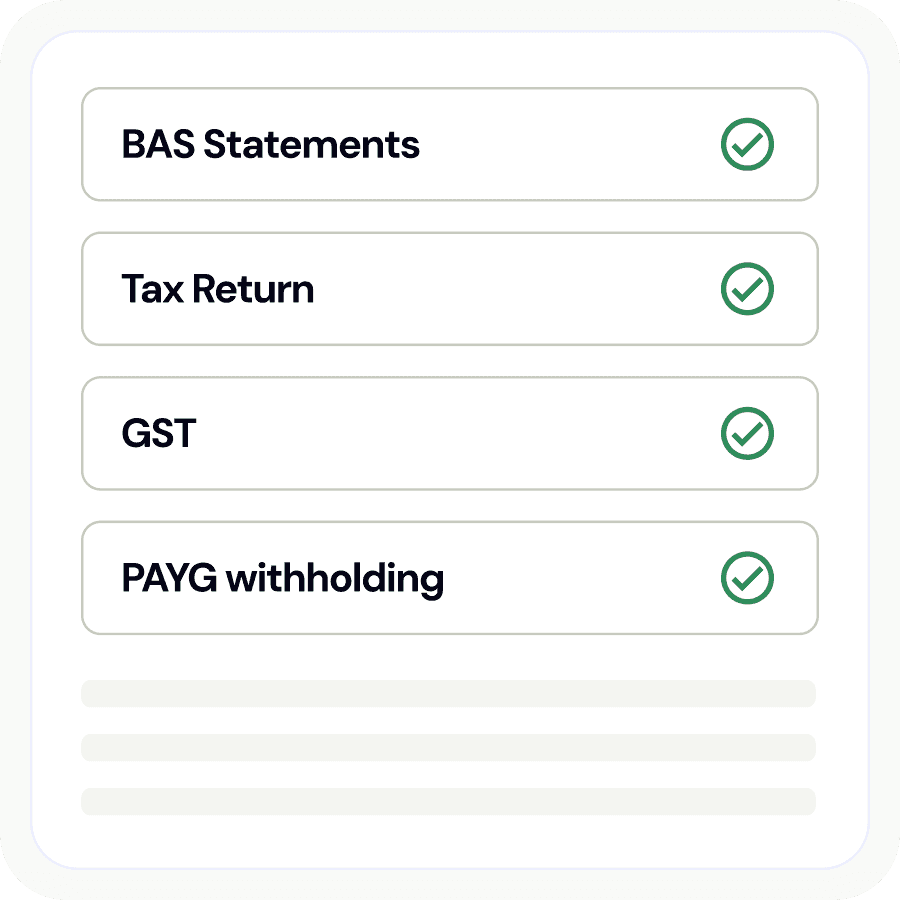
- BAS (Business Activity Statements): You must also lodge BAS statements if your business is registered for GST or PAYG withholding.
- Employers: If your business has employees, you must also report payroll and superannuation data through STP.
Failing to lodge returns can attract penalties, interest charges, or enforcement actions from the ATO.
Directors’ and founders’ responsibilities
Company directors have specific obligations to ensure their companies comply with tax law. As the director, you can be personally liable for unpaid PAYG withholding and superannuation guarantee amounts under the Director Penalty Regime.
Similarly, founders must also properly establish business structures and compliance systems to protect themselves from personal liability cascading from company issues.
For both roles, effective governance and record-keeping are key safeguards.
Why tax planning matters (not just tax lodgement)
Submitting returns and paying tax are compliance essentials, but tax planning takes that one step further. Effective tax planning increases cash flow efficiency, minimises risk, and positions your business for sustainable growth.
Tax planning vs tax compliance
Tax compliance means meeting lodgement deadlines and paying the correct amounts.
Tax planning, by contrast, is proactive. It considers your structure, income timing, deductions, and growth strategy to manage future obligations strategically.
Good planning looks ahead: how upcoming purchases, expansions, or changes might affect tax outcomes months or years down the track.
When businesses should consider professional tax planning
Professional tax advice becomes particularly valuable when:
- Your business is growing or hiring.
- You’re considering a new structure (e.g., incorporating or setting up a trust).
- You face cash flow pressure and need predictable PAYG instalments.
- You plan international expansion or onshoring operations.
Regular reviews with advisors will help you catch problems early, instead of waiting for the ATO to intervene.
FAQs: Key tax laws in Australia
What are the main tax laws Australian businesses must comply with?
Australian businesses must comply with many federal and state taxes, including:
- Income tax
- Goods and Services Tax (GST)
- Pay As You Go (PAYG) withholding and instalments
- Fringe Benefits Tax (FBT)
- Payroll tax (state-based)
- Stamp duty on certain transactions
Remember that it’s critical to check your exact obligations, depending on your business structure, location, industry, and other factors.
Do all businesses need to register for GST?
No. Only businesses with an annual turnover of $75,000 or more ($150,000 for non-profits) must register for GST. However, smaller businesses can choose to register voluntarily to claim input tax credits. Taxi and ride share drivers must register for GST regardless of turnover.
What happens if I miss a tax lodgement deadline?
Missing a tax deadline can result in penalty fees, interest charges, and potential ATO enforcement action. If delays are due to genuine hardship, you should contact the ATO early to discuss payment or lodgement extensions.
Is PAYG tax different from income tax?
Yes. PAYG withholding and PAYG instalments are prepayments of income tax throughout the year. They’re mechanisms for spreading tax obligations rather than separate taxes themselves.
Do small businesses pay Fringe Benefits Tax?
They might, but only if they provide non-cash benefits like vehicles, entertainment, or housing. If no such benefits exist, most small businesses don’t incur FBT, though it’s important to check annually.
How do I know if my business structure is tax-efficient?
The right structure depends on your turnover, risk profile, and long-term goals. A sole trader offers simplicity but limits protection. Companies and trusts provide flexibility for income distribution. Speaking with a registered tax professional helps identify the most tax-effective option.
When should I speak to a tax professional?
Any time your business experiences growth, adds employees, changes structure, or expands internationally. Early advice often prevents long-term complications and unnecessary tax payments.
How Lawpath supports Australian businesses with tax planning
Navigating Australian tax law doesn’t have to be overwhelming. Lawpath helps businesses by providing access to legal and tax professionals, document templates, and resources that explain complex obligations in plain language.
Rather than offering tax advice directly, Lawpath equips you with the structural clarity needed to make informed decisions, so you can manage tax compliance confidently while focusing on business growth.