
Tom Willis is an award-winning marketing leader and Co-founder of Lawpath. Tom’s journey journey includes steering several entrepreneurial projects and addressing the unique challenges faced by small businesses. As the Chief Marketing Officer at Lawpath, Tom has been pivotal in shaping the company’s marketing strategy and business growth.
Ask most Australians to picture a small business and they’ll describe a café on a regional high street, or a florist with a striped awning. It’s a lovely picture, but it’s not the reality of who’s starting businesses anymore.
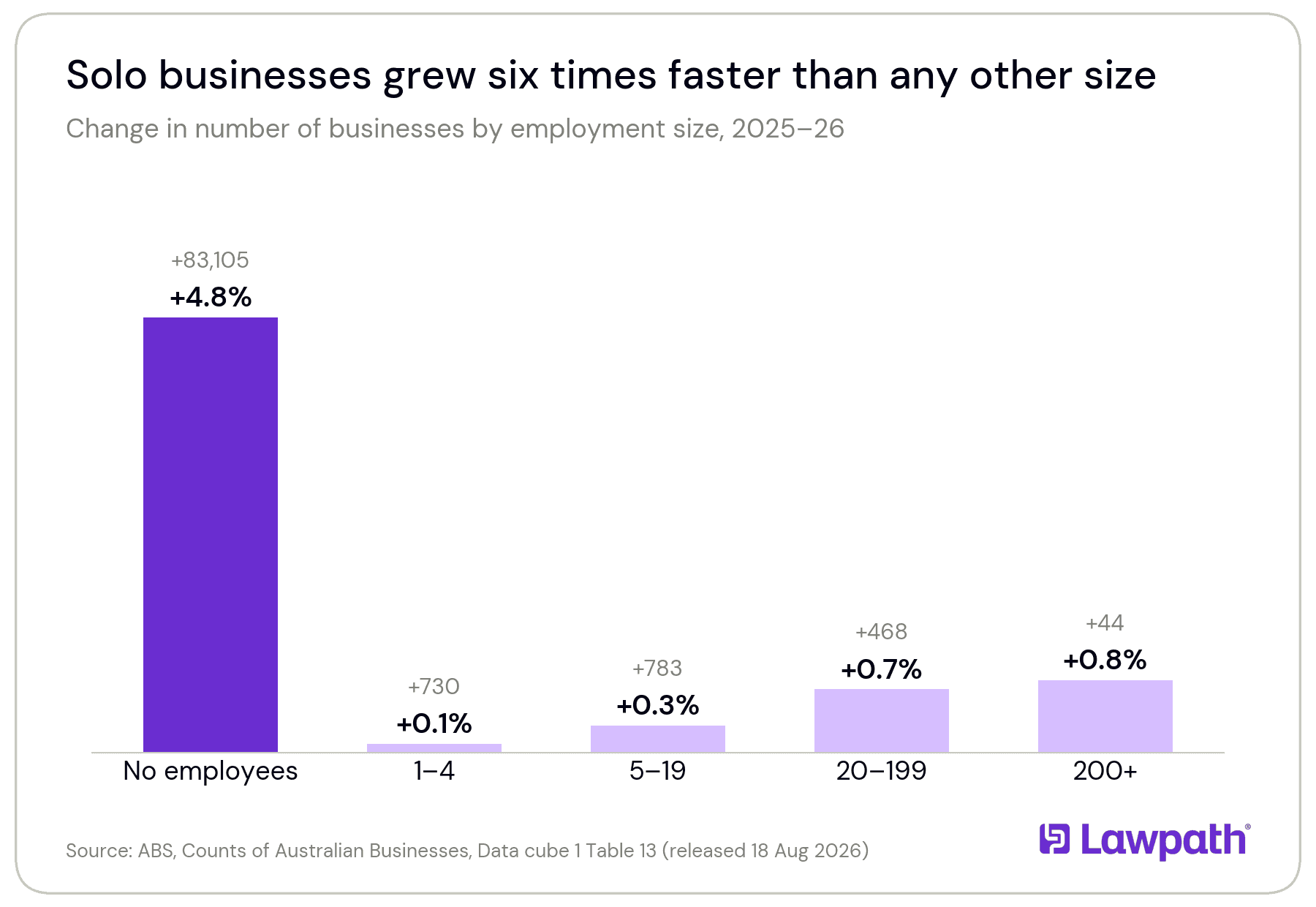
The ABS counted 2,814,778 actively trading businesses at June 2026, and businesses with no employees accounted for 83,105 of the 85,130 net increase over the year. That has big implications for how we support, fund and build services for small business.
Lawpath has now supported more than 650,000 Australian businesses, and the founders I talk to look nothing like the postcard. A physio renting a room two days a week. A mobile welder with a ute for an office. A consultant in a home office. Yet the postcard still shapes how grants get written, loans get assessed and “small business confidence” gets measured.
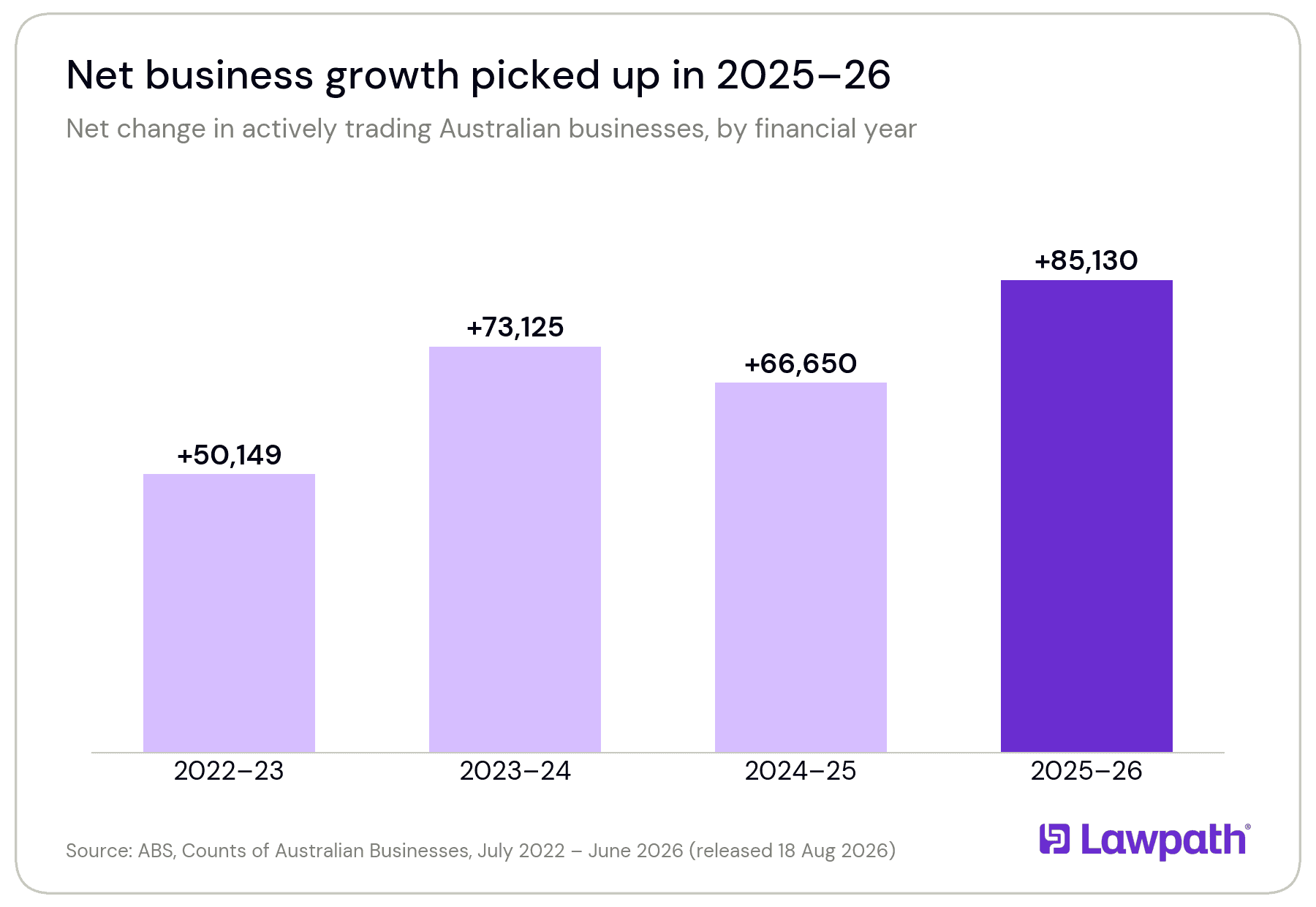
- Small business is growing, not shrinking. Australia added a net 85,130 businesses in 2025–26 (up 3.1%), the fifth straight year of net growth.
- Nearly all of that growth had no staff. Non-employing businesses grew by 83,105 and now make up 64.6% of all trading businesses.
- Employing businesses are growing again. They rose by 2,025 to 996,203, the first increase since 2021–22, and every employee size band grew.
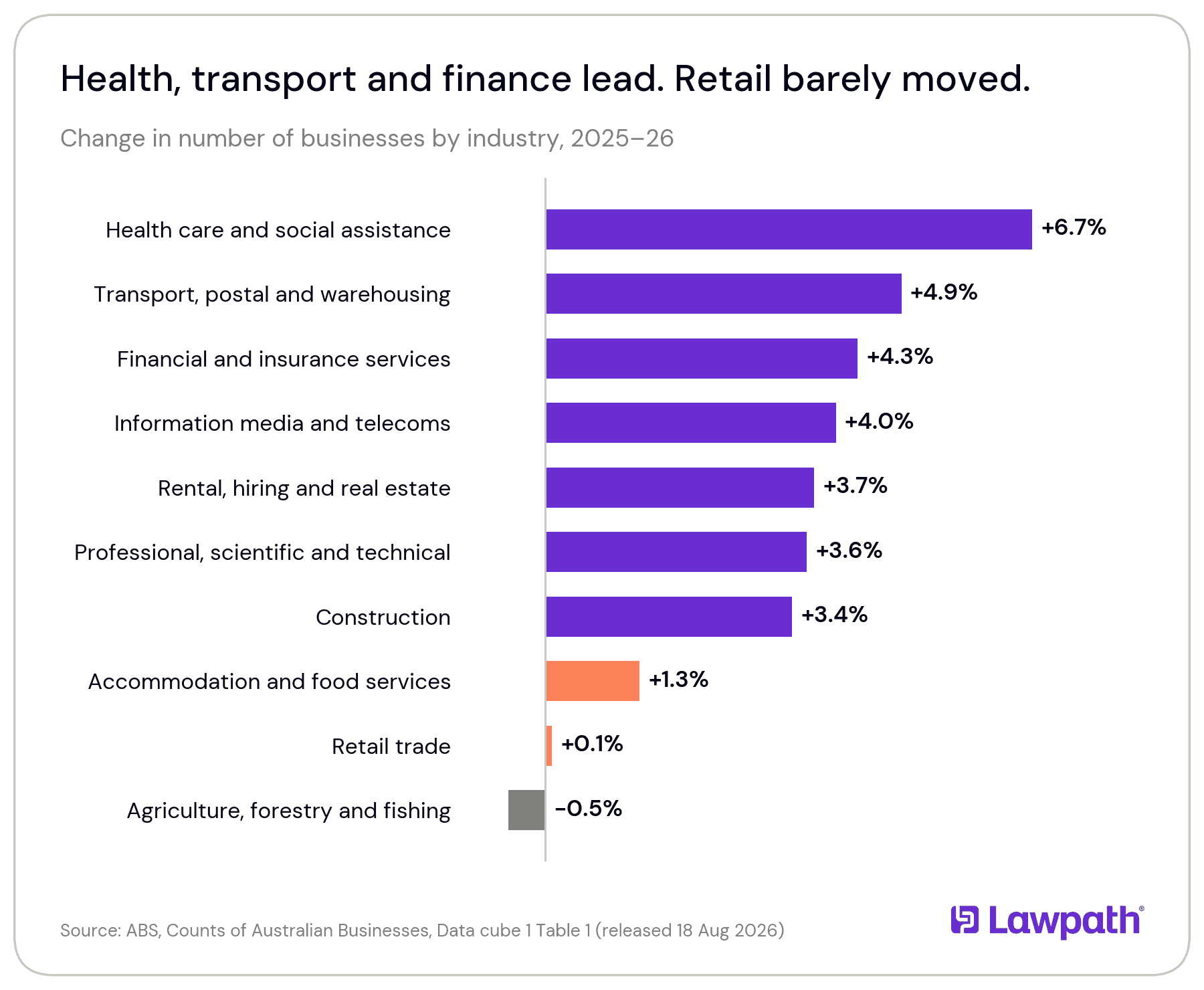
- Trades, health and transport lead, not retail. Construction added 15,603 businesses and health care grew 6.7%, while retail grew by just 125.
- Growth is suburban. Lawpath’s New Business Index shows the fastest registration growth in outer-metro corridors like Wyndham, Casey and Hume, not CBDs.
Is Australian small business growing or shrinking?
Whichever way you look at it, Australian small business is growing. The ABS Counts of Australian Businesses puts the total at 2,814,778 actively trading businesses at 30 June 2026. That’s up 85,130, or 3.1%, in a year. Fifth year of growth in a row.
But look at where the growth is happening.
Healthcare and social assistance businesses grew 6.7%. Transport and delivery grew almost 5%. Financial services grew more than 4%.
Meanwhile, retail barely moved, up 0.1%. Hospitality grew just 1.3%.
So increasingly, the Australian small business looks like a consultant with a laptop. A carer working across different locations. A courier with a van. An adviser working from home. A tradie running the business from their phone.
And one number really drives this home. Businesses with no employees were the fastest-growing segment last year, up 4.8%. That’s 83,105 more businesses without a single employee, and almost all of the year’s net growth.
Under that headline there’s a lot of movement. Entries and exits totalled roughly 836,000 last year, about 31% of the business count on our calculation.
If you want the full set of numbers, including employment and failure rates, our small business statistics guide breaks them all down.
Now look at the other side of it. Australia’s national office vacancy rate hit 16.1% in the Property Council’s July 2026 Office Market Report, its highest level since 1995.
Five years of business growth. Thirty-year-high office vacancy. Australia keeps adding businesses, but they aren’t filling offices.
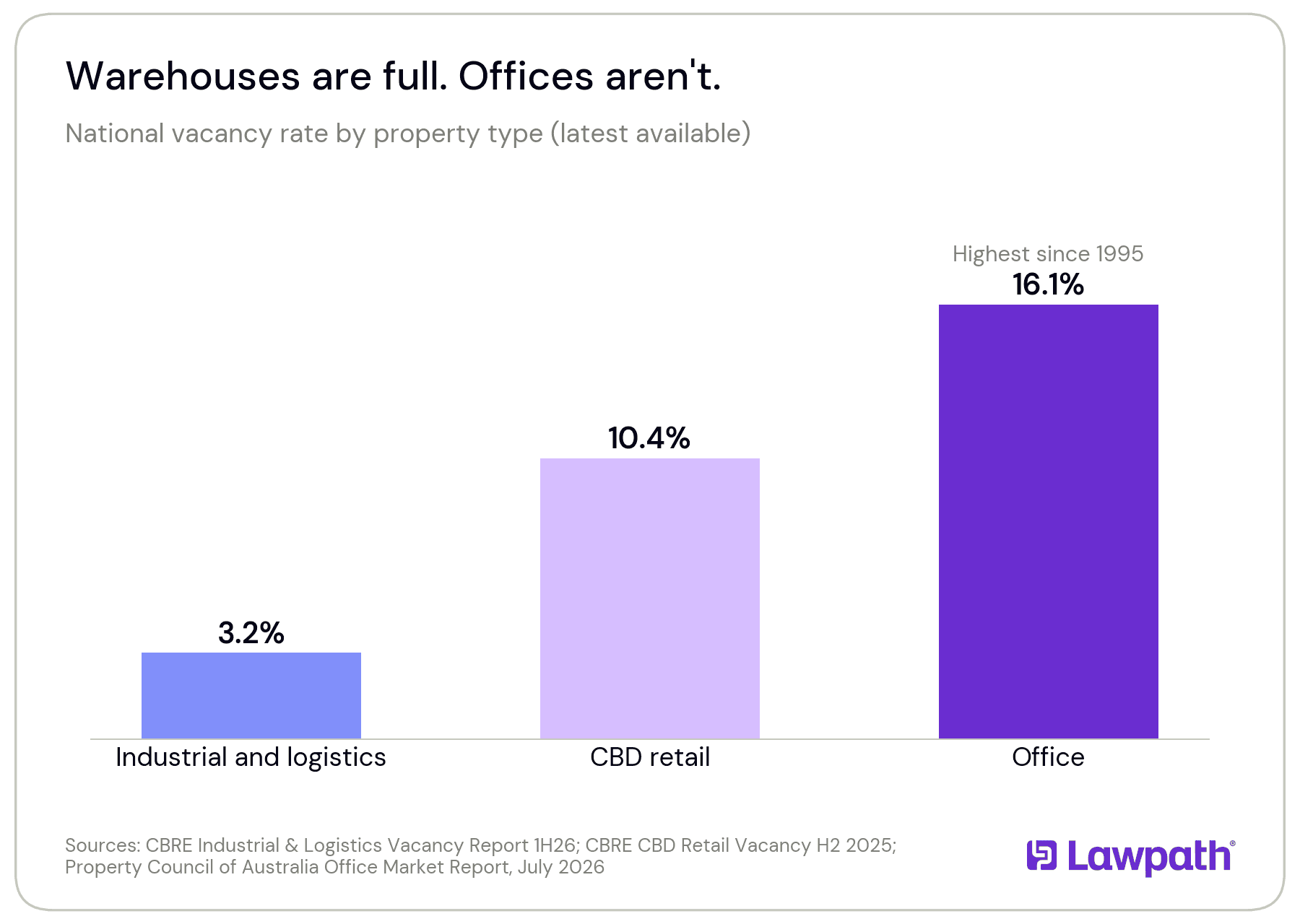
New office supply is part of that story, and vacancy data can’t tell us exactly where founders work. But the direction is clear: the way Australians build businesses is changing.
Which industries are driving the changing face of small business?
Construction, health care, professional services and transport account for much of the increase. Retail and hospitality are growing much more slowly.
| Industry (ABS division) | Businesses at 30 June 2026 | Net change 2025–26 | Entries 2025–26 |
|---|---|---|---|
| Construction | 478,651 | +15,603 (+3.4%) | 83,004 |
| Health Care and Social Assistance | 227,702 | +14,278 (+6.7%) | 37,117 |
| Professional, Scientific and Technical Services | 366,289 | +12,804 (+3.6%) | 60,636 |
| Transport, Postal and Warehousing | 261,109 | +12,127 (+4.9%) | 66,091 |
| Rental, Hiring and Real Estate Services | 319,717 | +11,511 (+3.7%) | 40,396 |
| Financial and Insurance Services | 139,417 | +5,749 (+4.3%) | 22,274 |
| Accommodation and Food Services | 114,369 | +1,498 (+1.3%) | 19,260 |
| Retail Trade | 156,143 | +125 (+0.1%) | 24,568 |
| Agriculture, Forestry and Fishing | 170,185 | −861 (−0.5%) | 12,608 |
Retail shows why net growth needs context. There were 24,568 entries in 2025–26 and about 24,443 exits. The total barely moved, but thousands of operators came and went. Retail had shrunk 0.4% the year before.
Transport runs hot in both directions, with the highest entry rate of any industry (26.5%) and an exit rate of 21.7%. Couriers, owner-drivers and delivery operators find it easy to start, but they are not often businesses set up for the long run.
Our registration data shows a similar mix. In Lawpath’s August 2026 New Business Index, personal services made up about 21% of new companies on our platform and construction about 20%. Retail was under 8%, and accommodation and food services around 2%. Cafés are real. They’re just not the engine.
Who is starting businesses in Australia now?
People working alone account for most of the growth. By June 2026, 1,818,575 actively trading businesses had no employees, or 64.6% of the total.
Sole proprietors grew 3.1% to 848,300. Companies grew faster, up 5.2% to 1,271,197, with 205,319 new company entries. Partnerships went the other way, down 4.2% to 196,015.
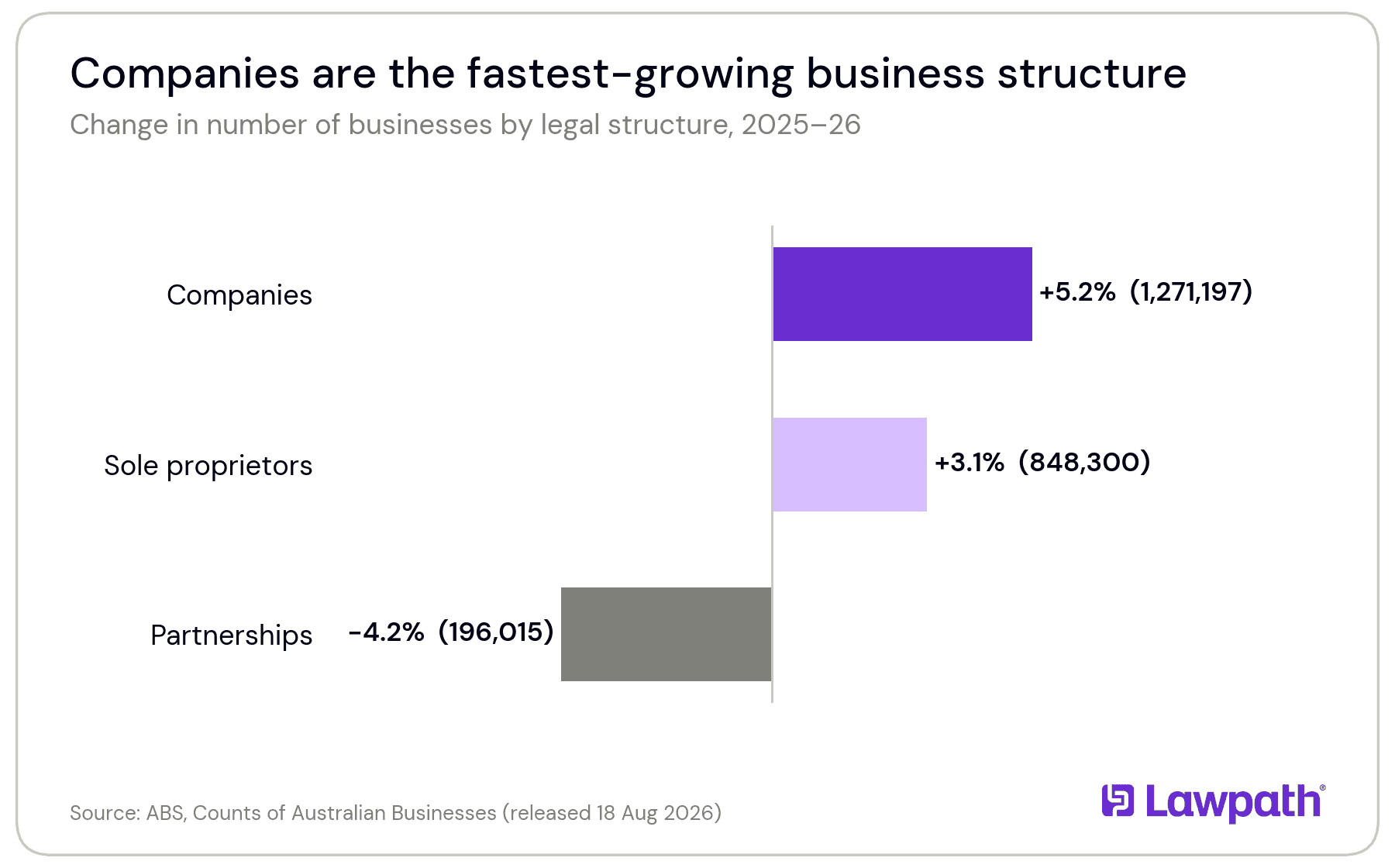
Structure and staff numbers measure different things. A company can have no employees, and a sole trader can employ a team. Our guide on when to incorporate your business covers the factors worth weighing.
Registration data shows the same lean shape earlier in the pipeline. Lawpath’s FY26 New Business Index counted 1,380,611 new ABNs, up 31.3%, and about 72% were sole traders. ABN registrations measure intent rather than trading, so they run much higher than the ABS count.
The founders don’t match the postcard either. On our platform in FY26, the largest age group was 45 to 54 (20%), founders aged 55 and over were the fastest-growing group (up 34.5%), and about 66% were born outside Australia. Older founders aren’t new: back in 2004, the ABS found 31% of small business operators were over 50. This is a large market of experienced people building businesses around skills they already have.
Isn’t this just gig workers and side hustles?
It’s a fair question, so let’s call it out. Not every one of those 83,105 new non-employing businesses is a founder with a plan.
Rideshare drivers have to register for GST from their first dollar, so they can appear in the transport count. Independent NDIS support workers can appear in health care. Non-employing businesses also include property trusts and holding companies. Some of the growth will be side hustles started out of necessity.
Independent contractors are part of this picture too. Construction, health care and professional services had the most independent contractors in the ABS’s last two working arrangements surveys, and those industries are leading business growth now. The data runs on a different timeline, so we’ll look at it more closely when the ABS releases its next working arrangements figures in November.
Solo businesses also turn over faster. Their exit rate was 17.2% last year, against 7.7% for employing businesses.
So if the whole story were gig work and necessity, you’d expect the businesses that hire people to be going backwards. A year ago, that’s what the commentary said was happening. Employing businesses fell 0.5% in 2024–25, and “death of the small employer” headlines followed.
Then the 2025–26 numbers came in.
Employing businesses grew by 2,025 to 996,203, the first rise since 2021–22. Every employee size band grew. Around 106,000 employing businesses started and 76,000 closed. Fewer employers dropped back to going solo, too: 28,127, down from 32,428 the year before.
Platform work itself is shrinking. ABS figures show 178,500 people did digital platform work in 2024–25, down 11% on the year before, and only 39% said it was their main job.
Gig work is part of the picture, but not the whole picture. Businesses without employees account for most of the growth, and the businesses that hire are growing again. That looks less like a workforce being pushed out and more like a different path into business, where the first hire comes later. If that’s you, it helps to know that sole traders can hire employees without incorporating first.
How many Australian small businesses are run from home?
We don’t have a current official count, and that’s a significant gap.
In June 2004, the ABS Characteristics of Small Business survey found 856,000 home-based small businesses, about 67.5% of all small businesses in the country. Of those, 95.8% had no other premises at all, and 68.8% employed no one.
Back then, the ABS described the most common small business operator as a middle-aged man working 35 to 50 hours a week, from home, with no staff. Not a café. A spare room.
The survey’s final release was in 2005–06. The ABS business count measures industry, size and turnover, but not whether a business operates from home.
What the modern signals tell us
| Signal | Figure | What it does (and doesn’t) tell you |
|---|---|---|
| ABS Working arrangements, August 2025 | 36% of employed people usually worked from home. Of those, 21.9% said the main reason was operating a business from home or a home-based job, second only to working more flexibly (22.5%). | Home-based business activity is still happening at scale. It’s a share of workers, not a share of businesses. |
| ABS CABEE, 30 June 2026 | 64.6% of trading businesses are non-employing | The structure looks a lot like 2004’s home-based profile. It doesn’t prove where those businesses operate. |
| ABS Working arrangements, August 2025 | 1.1 million independent contractors (7.6% of employed people), up 33,000 in a year, led by construction, health care and professional services | A large, premises-light workforce in the same industries driving business growth. It measures employment type, not premises. |
| NSW Small Business Commissioner, Home Business Survey Report 2019 | Of 460 NSW home business owners surveyed, 74% were sole traders and 69% were in metro areas | Useful colour on who runs a home business. It describes the people who answered, not every home business in NSW. |
None of these gives us a current share. My view? The spare room hasn’t lost ground. We’ve just stopped counting it.
Countries that still measure it see the same pattern. The US Small Business Administration found home-based firms made up 60.1% of businesses with no employees but only 23.3% of small employers, and UK data in an OECD policy brief shows a similar split. Home is the default address, at least until a business needs to put someone on the payroll.
Where are new Australian businesses locating?
In and around the capital cities, but increasingly in the suburbs. Every state and territory grew in 2025–26: New South Wales added the most businesses (26,057) and Western Australia grew fastest (4.6%). Lawpath’s 2025 Year in Review found registrations spreading beyond CBDs, and in FY26 the strongest local growth came from outer-metro corridors like Wyndham, Casey and Hume. The volume leaders are postcodes like Point Cook, not Martin Place.
Starting a small business today? What to get right first
The foundations are easier to get right at the start than to fix later.
- Choose a structure on purpose. About 72% of new ABNs are sole traders, but popularity shouldn’t decide it. If liability or investors are on the horizon, register a company before you start trading.
- Read your employment contract before you resign. If you’re starting in the industry you’ve just left, restraint and confidentiality clauses matter.
- Make IP ownership clear. Put domains, trademarks and designs in the business’s name before you bring in a partner, raise capital or sell.
- Check the rules for where you actually work. Council home business rules, strata by-laws and lease terms apply to spare rooms and garages too.
- Plan the first hire before you need it. Know your award, super and payroll obligations, and build the full cost of employment into your cash flow.
The modern Australian business can start with one person, one skill and a laptop, phone, van or spare room. And right now, more Australians are starting them every year.
If you’ve got the skill, the idea or the first customer, Lawpath can help you turn it into a business. Register your business with Lawpath and get started.
Frequently asked questions
What is the changing face of small business in Australia?
It’s the shift from staffed shopfronts toward sole operators in services, trades, health and transport. In 2025–26, non-employing businesses made up 83,105 of Australia’s 85,130 net new businesses, while retail grew by just 125 businesses.
How many Australian businesses are home-based?
There’s no current official figure. The last ABS count, in June 2004, found about 67.5% of small businesses were home-based. In August 2025, 21.9% of people who usually worked from home said running a business from home or a home-based job was the main reason.
Is the growth in Australian businesses just gig workers?
Partly, but not entirely. Rideshare drivers, NDIS support workers and property trusts all add to the count of businesses with no employees. But employing businesses also grew in 2025–26, up 2,025 to 996,203, and digital platform work fell 11% in 2024–25.
Are small employers disappearing in Australia?
No. Employing businesses rose by 2,025 in 2025–26, the first increase since 2021–22, and every employee size band grew. Growth is still dominated by businesses with no employees, but the employing base has stabilised.
Can I run a business from home in Australia?
Yes, and many small businesses do. Check your council’s home business rules, any strata by-laws or lease conditions, and whether you’re comfortable using your home address on public registers. Keep business and personal expenses separate from day one.