Casual Loading: When Do Employers Pay It?
Employers should be aware of when they need to pay their employees casual loading. Keep reading to find out when this applies.
Take control of your time. Get access to legally verified legal documents quickly.
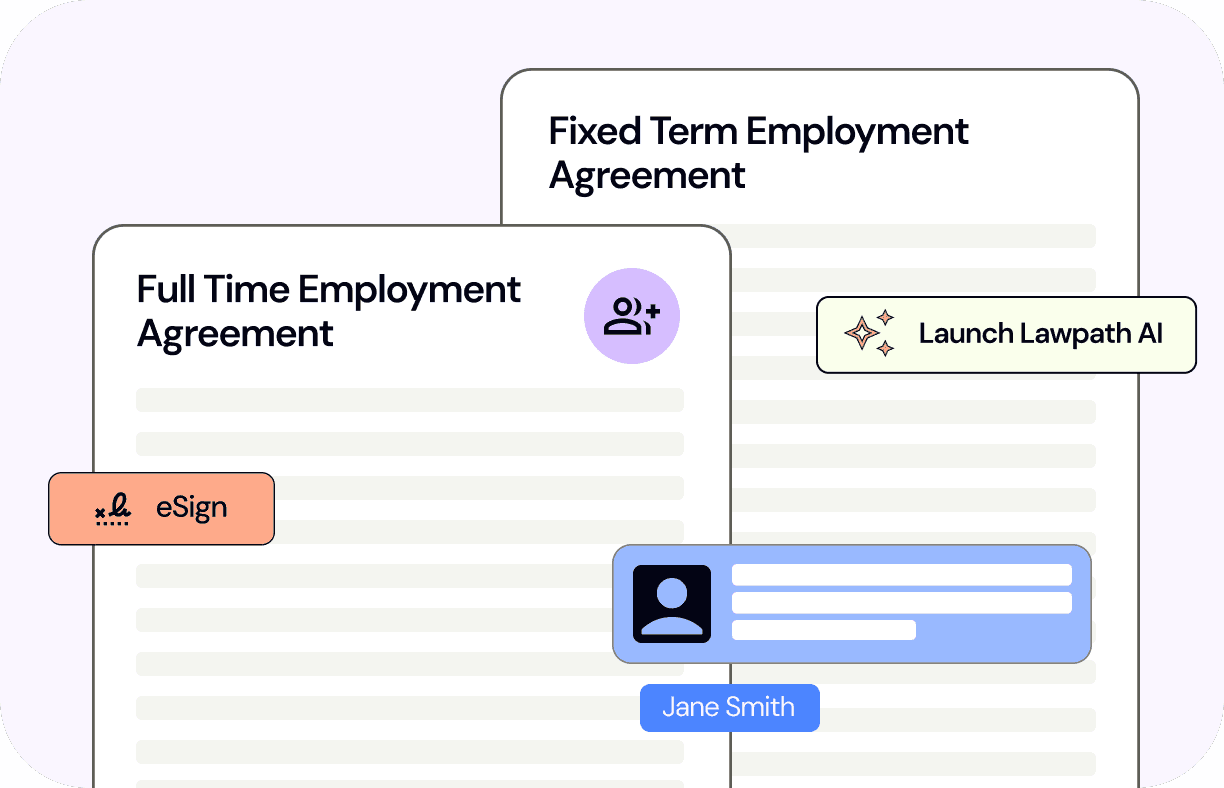
This is the first question Lawpath lawyers hear from business owners hiring staff. The answer depends on the hours, the commitment, and what you can offer.
| Employment type | Hours | Leave entitlements | Best for |
|---|---|---|---|
| Full-time | 38 hours/week (ongoing) | Annual, personal, compassionate, parental leave | Core team members with predictable workloads |
| Part-time | Under 38 hours/week (set schedule) | Same as full-time, pro-rated | Roles with regular but reduced hours |
| Casual | Variable, no guaranteed hours | No paid leave (offset by 25% casual loading) | Seasonal, shift-based, or demand-driven work |
| Fixed-term | Full-time or part-time for a set period | Same as permanent (pro-rated if part-time) | Project-based roles, parental leave cover, seasonal peaks |
Not sure? Start with the casual employment contract if your new hire’s hours will vary week to week. Go with full-time if the role has consistent, ongoing hours at 38 per week.
Every employment contract in Australia needs to cover the basics: the employee’s role and responsibilities, pay rate, ordinary hours, leave entitlements, notice period for termination, and any probationary period. Beyond these, the clauses that actually protect your business are the ones most people skip.
Lawpath lawyers consistently flag three clauses that business owners forget to include: intellectual property assignment (who owns work product created during employment), confidentiality obligations that survive termination, and restraint of trade provisions if the employee has access to clients or sensitive information. These aren’t optional extras. They’re what stops a departing employee from walking out the door with your client list.
Your contract must also comply with the applicable Modern Award for your industry. The Award sets minimum pay rates, penalty rates, overtime, and allowances. Your contract can offer more than the Award, never less. If you’re not sure which Award applies, the Fair Work Ombudsman has a Find My Award tool that takes about two minutes.
Across hundreds of consultations every year, Lawpath lawyers see the same patterns from business owners creating their first employment contract.
“Do I need a different contract for each employee?” Yes. A casual contract and a full-time contract are not interchangeable. The leave entitlements, notice periods, and termination rules differ between each type. Use the comparison table above to pick the right template, then customise it for the specific role.
“I’ve been using contractors. What changes when I hire an employee?” Quite a lot. You’ll need workers’ compensation insurance, superannuation contributions (currently 12% of ordinary time earnings), and you’ll be responsible for PAYG withholding. The employment contract itself replaces the contractor agreement. Misclassifying an employee as a contractor is one of the most expensive mistakes a small business can make, and the Fair Work Act was amended in 2024 to look at the “real substance” of the relationship, not just what the contract says.
“What happens if my contract accidentally offers below the Award rate?” The Award overrides the contract. But you’ll still owe the difference as backpay, potentially with interest and penalties. Getting the rate right from the start is cheaper than fixing it later. If you’re unsure about the correct rate, a 30-minute consultation with a Lawpath employment lawyer can confirm it before you make the offer.
Step 1: Choose your template. Pick the employment type from the table above. Each template is built by employment lawyers and covers the NES, Modern Award interaction, and standard protective clauses.
Step 2: Customise it. Lawpath’s guided questionnaire walks you through every clause in plain English. Add the role details, pay rate, hours, probation period, and any specific clauses you need (IP, confidentiality, restraint of trade). Takes about 10 minutes.
Step 3: Send it for signing. Use Lawpath’s built-in e-signature to send the contract to your new hire. Electronic signatures are legally valid in Australia under the Electronic Transactions Act 1999. Both parties get a signed copy stored in your Lawpath account.
Need a lawyer to review the contract before you send it? Lawpath’s Legal Advice Plan gives you unlimited 30-minute consultations with employment lawyers who’ve seen every variation of this.
You can create your first employment contract free when you sign up. After that, the Essentials Plan gives you unlimited access to all 550+ legal document templates, including every employment agreement type.
Yes. Once both parties sign, the contract is enforceable under Australian law. Lawpath templates are drafted by qualified Australian lawyers and updated regularly for legislative changes including recent Fair Work Act amendments.
Every template is fully editable. You can add industry-specific clauses, adjust the role description, set your own probation period, and tailor restraint of trade provisions. The guided questionnaire prompts you through each decision.
Yes. Your contract sets out the agreement between you and your employee, but the applicable Modern Award sets the minimum floor. The contract can offer more generous terms, never less. Use Fair Work’s Find My Award tool to identify which Award applies.
An employment contract is between one employer and one employee. An enterprise agreement covers a group of employees and must be approved by the Fair Work Commission. If an enterprise agreement applies, your employment contract sits alongside it but can’t undercut its terms.
Only with the employee’s written consent, unless the contract includes a specific variation clause. Any changes must still meet NES minimums and Award requirements. Lawpath has a Letter to Amend Employment Agreement template for exactly this.
Not necessarily. Lawpath’s templates handle most standard employment arrangements without a lawyer. For complex situations like executive-level hires, restraint clauses in competitive industries, or employees covered by multiple Awards, a 30-minute lawyer consultation is worth it.
At minimum: the signed employment contract, the Fair Work Information Statement (FWIS), a Tax File Number declaration, and a Superannuation Standard Choice form. Casual employees also need the Casual Employment Information Statement. Fixed-term employees need the FTCIS.
Hiring your first employee is a big step, but the paperwork doesn’t have to slow you down. Pick the right template, customise it in 10 minutes, and get back to running your business.
Create your free account
Find the document you need from our library
Answer a few simple questions to tailor your document
Review, download and share your finished document
Employers should be aware of when they need to pay their employees casual loading. Keep reading to find out when this applies.

FInd out how to add a residential address to your company and update your company address after registration.

Can an offer of employment be withdrawn? Read this article to find out when an employer can and can’t withdraw an offer of employment.
Sign up to a free Lawpath account and get started.
Our experienced lawyers are here to help.