


Dominic is the CEO of Lawpath, dedicating his days to making legal easier, faster and more accessible to businesses. Dominic is a recognised thought-leader in Australian legal disruption, and was recognised as a winner of the Australian Legal Innovation Index and recently a winner of the LexisNexis 40 Under 40 (APAC).
A SWOT analysis is a central part of any good business plan.
A SWOT analysis – short for Strengths, Weakness, Opportunities, Threats – is a tool to help you identify the internal and external pain points affecting your business to make the right decisions to respond. If you’re an existing business, a SWOT analysis can be useful at any stage of your business; whether you’re thinking of introducing a new product, or you’re reacting to a change [in your industry’s environment].
Whichever stage your business is at, a SWOT analysis can help you to;
- Build on strengths (Internal);
- Improve or reduce weaknesses (Internal);
- Identify new opportunities (External); and
- React to threats (External).

Create your own Business Plan for free.
Customise, update and download our Business Plan.
Get started

Before you get started
Start with an objective
A SWOT analysis is only as effective as you make it. Have a clear objective or question in mind before you start, i.e. introducing a new product, changing a process or jumping on new opportunity.
Tip: Try to condense your objective to one sentence and refer back to it throughout the SWOT analysis.
Get informed
Analyse the internal processes of your business, research emerging trends in your industry and understand the current state of the market. Being informed will help you to paint a complete and realistic picture of the internal and external factors before you start to make decisions.
Tip: Conducting or purchasing market research can give you clear answers about your competitors and where your business or service fits in.
Creating a SWOT analysis
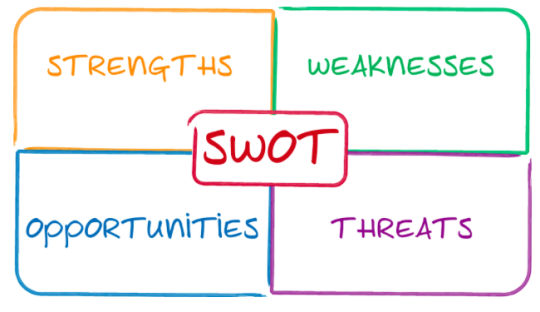
A SWOT analysis is a simple tool and be conducted using a four-square template (see below). Brainstorm and identify factors for each category, remembering to be as concise as possible – dot-points work best! If you’re conducting a SWOT anaylsis as part of a large group, you may want to split into smaller groups, coming back together to identify the most important and relevant factors.
Strengths (Internal)
List all of the things your business is good at, both tangible (i.e. credit, technology) and intangible (i.e. reputation). How does your business stand out from your competitors and what are your advantages?
Examples include: price point, online and physical services, customer service.
Weaknesses (Internal)
When listing your weaknesses, be honest with yourselves. Internally, how could your business improve and operate more effectively? What resources do you need to grow, and what may need consolidating? In comparison to your competitors, what are you lacking or missing?
Examples include: the location of your business, your current market share, a lack of intellectual property.
Opportunities (External)
Now that you’ve reflected on the things your business can control, it’s time to think about positive external factors. What new opportunities exist in the market to help you get a competitive edge? Can your business take advantage of recent market growth?
Examples include: new technologies, expanding your customer base or attempting to capture new market share.
Threats (External)
Understanding external threats to your business is the most effective way to mitigate against risk. Identifying your existing or potential competitors is the easiest way to begin, but it’s important to also think more broadly about the current state of the market and where it may be headed.
Examples include: introduction of new disruptive technologies or products, a change in the supply change, consumer behavior trends and market changes.
Next steps
Once you have completed your SWOT analysis within your business plan and you have a prioritised final version, you can now develop strategies to address the various issues. Using your SWOT headings, change the proposition to focus on what you can do it about each factor.
For example, how can you apply your strengths to the new opportunities you have identified? How do you overcome your weaknesses and become more competitive? Remember the objective you started out with: have you addressed the issues, and are you now in place to implement a strategy to achieve your goals?







