
A legal and accounting advice plan is a fixed-fee subscription that gives your business unlimited 30-minute consultations with a lawyer and an accountant, so you can get advice the moment a question comes up instead of paying by the hour. With Lawpath, the legal side adds live chat and contract reviews, and the accounting advice plan covers tax, GST, payroll and compliance questions.
Here’s what most founders don’t realise until they’re stuck. The questions that keep you up at night rarely sit neatly on one side. “Should I move from sole trader to a company?” is a legal question and a tax question at once. Most law firms won’t touch the tax. Most accountants won’t touch the legal. So you pay two advisers to answer one question, or you put it off.
- One subscription, two advisers. A legal and accounting advice plan puts a lawyer and an accountant on the same fixed monthly fee, which matters because real business questions cross both.
- Almost any commercial question is in scope. Structure, contracts, employment, IP, disputes, GST, BAS, payroll, super and tax planning are all fair game.
- Bigger jobs get a fixed quote first. Drafting, lodgements and complex work outside the plan are quoted upfront at a member discount, so there’s no bill shock.
- Payday Super is now live. Since 1 July 2026, employers pay super every payday, and it must reach the fund within 7 business days.
- The cheapest advice is the advice you get before you act. Naming a trust as shareholder at incorporation, or checking director liability before you sign on, costs nothing to get right and a lot to undo.
Table of Contents
How does a legal and accounting advice plan work?
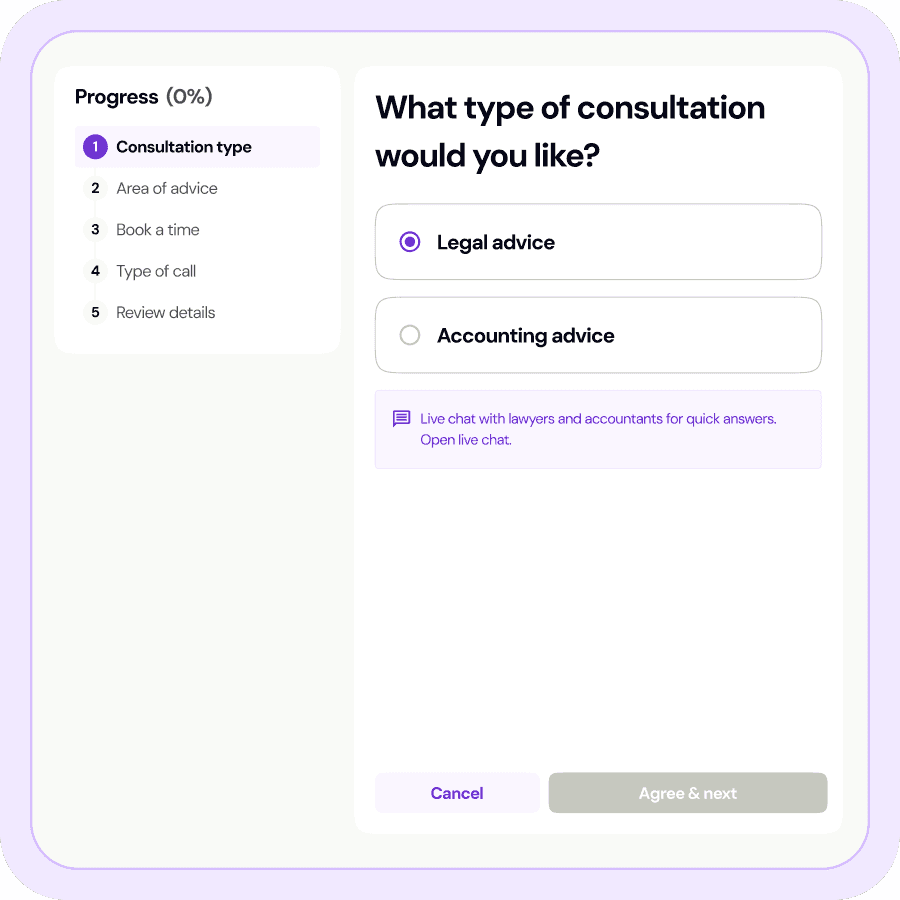
You pay a set monthly fee. In return you get unlimited 30-minute phone or video consultations with a commercial lawyer, an accountant, or both. Your first consult is booked within 24 to 48 hours of signing up.
Each side is its own plan, and you can bundle them. The Legal Advice Plan adds live chat for quick questions, contract uploads for review, and access to Lawpath’s library of 550+ legal document templates. The Accounting Advice Plan covers tax, accounting software and compliance questions. Bundle the two and you save 30% (see current plan pricing).
What isn’t included matters just as much. Drafting a bespoke agreement, running a dispute or preparing your BAS and tax return are hands-on jobs. They sit outside the consult, so you get a discounted fixed-price quote before anything starts. If you want lodgements handled every quarter, that’s Lawpath’s separate Tax Plan.
| What you get | Legal side | Accounting side |
|---|---|---|
| Unlimited 30-minute consults | Yes, with a commercial lawyer | Yes, with an accountant |
| Quick questions between calls | Live chat | Live chat |
| Document help | Contract reviews, 550+ templates | Accounting software help |
| Work outside the plan | Discounted fixed quote | Discounted fixed quote |
| Typical topics | Structure, contracts, staff, IP, disputes | GST, BAS, payroll, super, tax planning |
Why put both advisers on one subscription? Because the handoff is where things fall over. A lawyer setting up your company will explain the legal mechanics, then say “check the capital gains timing with your accountant.” On a combined plan, that handoff stays inside one subscription instead of crossing two firms and two invoices.
Is an advice plan cheaper than paying by the hour?
For most growing businesses, yes. The saving isn’t really the hourly rate. It’s that you stop rationing questions. When every call costs money, founders wait until a problem is big enough to justify the bill. By then it’s expensive.
| Advice plan | Hourly lawyer or accountant | |
|---|---|---|
| Cost of a quick question | Nothing extra | Billed, often in 6-minute units |
| Budgeting | One fixed monthly amount | Unpredictable |
| Legal and tax in one place | Yes, if you bundle | Usually two separate firms |
| Bigger projects | Discounted fixed quote | Hourly, estimate only |
| Best for | Ongoing, recurring questions | One complex matter, then nothing |
Let’s be candid about when a plan isn’t the right fit. If you need one document once a year and nothing else, a one-off template or fixed-fee job will cost less. If you’re in court proceedings or a large acquisition, that’s specialist project work. A plan helps you prepare, but it won’t run the matter inside the monthly fee.
The plan earns its keep when questions keep coming: you’re hiring, signing client contracts, moving structures or lodging BAS. That describes most businesses in their first five years.
What legal questions can you ask on an advice plan?
Pretty much any commercial legal matter. Below are the areas that come up most, plus the thing our lawyers wish people asked about sooner.
Company structure, trusts and restructuring
This is the single most common reason people book a first consult. Stay a sole trader, register a company, add a trust, or combine them? A company is a separate legal entity, so business debts generally stay with the company. A trust can hold the shares and spread income flexibly.
The trap we see most: founders bolt a family trust onto a company later, once someone tells them it’s “tax-effective.” Moving existing shares into a trust is a capital gains tax event. The fix is boring and free. If a trust will own the company, name the trust as shareholder on day one. Decide the end structure first. Build it once.
If you do use a trust, appoint a corporate trustee rather than acting as trustee yourself. It costs a little more and keeps trustee liabilities off your personal assets. Our guide on setting up a corporate trustee walks through the mechanics. And don’t over-build on day one. A full trust and holding company setup rarely pays for its compliance costs until the business is making real profit.
Becoming a director: check this before you say yes
A friend asks you to come on as a director. It feels like a favour. It can be a serious personal risk. Under tax law’s director penalty regime, directors can become personally liable for a company’s unpaid PAYG withholding, GST and super. That includes debts that built up before you joined: a new director has 30 days from appointment to get those debts dealt with before liability attaches.
Separately, the Corporations Act 2001 (Cth) makes directors personally liable for debts the company takes on while insolvent. Resigning later doesn’t wipe the slate for anything that happened on your watch. A short call before you sign the consent to act is one of the highest-value consults you’ll ever book. Sometimes the answer is “do due diligence first.” Sometimes it’s simply “don’t.”
Contracts and document reviews
Client contracts, supplier deals, website terms and NDAs. You can talk through what a clause means, what’s missing and what to push back on. Uploading a contract you’ve been sent is one of the most-used parts of the plan, because a second read is worth most before you sign.
A newer pattern: more founders arrive with contracts they’ve drafted using AI. The bones are usually fine. The problems sit in the joins, like a refund policy that contradicts the booking terms, or liability caps that don’t match your insurance. A review catches those before a customer does.
Small details matter too. When a company signs, section 127 of the Corporations Act sets out who can execute: two directors, a director and secretary, or a sole director in a one-director company. Get the signing block wrong and a clean deal can wobble months later.
Employment and contractors
Hiring is where good intentions meet sham contracting law. The mistake founders make is assuming the label settles it. Calling someone a contractor, giving them an ABN-based invoice and a contractor agreement doesn’t make them one. Since 2024, the Fair Work test looks at the real substance of the working relationship, including control and whether the work is ongoing.
Super is the other surprise. Many businesses assume contractors never need super. Not true. If you pay a contractor mainly for their labour, super guarantee law can treat them as an employee for super purposes, even when they’re a genuine contractor everywhere else. Our accountants regularly calculate super on the labour component of contractor invoices for exactly this reason.
If someone is an employee, put the relationship in writing with one of Lawpath’s employment agreements, then check which award applies. Common questions here: Employee or contractor? Which award covers my staff? How do I end the relationship without a dispute?
Intellectual property and trade marks
Your brand and ideas are often the most valuable thing you own, and the easiest to lose by accident. Use a consult to work out what’s worth protecting and whether to register a trade mark.
Two patterns repeat in our IP consults. First, people file a logo mark when a word mark gives broader protection, and logo and name need separate applications anyway. Lock in the Australian word mark first. Second, ownership. Founders build the product personally, then incorporate, and never move the IP into the company. Same problem when a developer or agency built it. Without an IP assignment deed, the company may not own its own core asset. Investors and buyers check this first.
Debt recovery and disputes
Chasing money is stressful and easy to put off. A consult maps the steps: when a letter of demand is the right first move, what to put in it, and when to escalate to a statutory demand or a tribunal. Most disputes settle once the other side sees you’re organised. Good paperwork does a lot of the work.
Co-founders, shares and capital raising
Bringing on a co-founder, issuing shares, running an ESOP or taking money through a SAFE or convertible note. These are the moments where doing things in the wrong order gets expensive. Sort a shareholders agreement before anyone gets equity, and think about vesting so an early exit doesn’t walk off with a chunk of your company.
One gap our lawyers flag constantly: 50/50 companies with no deadlock clause. Two equal owners, no tie-breaker, and suddenly nothing can be decided. An escalation step plus binding expert determination costs a paragraph to add now. Fixing it mid-argument costs far more.
Which type of accounting is required by law?
Australian law doesn’t require one “type” of accounting. It requires records that correctly explain your transactions and financial position. The ATO says to keep most business records for 5 years, and digital copies are fine. Companies face a higher bar: the Corporations Act requires financial records to be kept for 7 years.
The real choice is cash or accrual. Cash accounting records income when money lands. Accrual records it when you raise the invoice. For GST, businesses with aggregated turnover under $10 million can usually choose to account on a cash basis. That helps cash flow, because you don’t hand the ATO GST on an invoice your customer hasn’t paid yet. The ATO’s record-keeping rules for business set out the detail.
What actually goes wrong in practice isn’t the method. It’s records that live in three places: the business account, a personal card and a founder’s head. Pick one business bank account, connect it to cloud software, and keep proper tax invoices rather than order confirmations. Our guide on why accurate financial records matter covers the rest.
What accounting and tax questions can you ask?
The accounting advice plan covers the questions that decide how much tax you pay and whether the ATO comes knocking. Tax advice is provided through Lawpath Tax & Advisory, Lawpath’s registered tax agent.
GST and BAS
You must register for GST once your turnover reaches $75,000 ($150,000 for not-for-profits). You can register earlier if it suits you. After that you lodge a BAS and account for GST collected and credits claimed.
Two things trip people up. You can’t claim GST credits on purchases made before you registered, but those costs may still be deductible for income tax. Different systems, different rules. And on the other side, a contractor who is registered for GST must charge it, even if their turnover is under $75,000. We regularly see GST-registered contractors send invoices without GST, which throws out both businesses’ BAS.
If a BAS is overdue, lodge it anyway, even if you can’t pay. Failing to lodge attracts its own penalties on top of the debt. The ATO is more open to payment plans than most people expect, and an accountant can often fold the overdue amount into an existing arrangement.
Tax planning and deductions
What’s deductible, where the line sits between business and private use, and how to treat a vehicle or equipment. The win is timing. Make deduction decisions before 30 June, not after. Bring your profit and loss to a call in May and you’ll get a realistic tax estimate instead of a shock at lodgement.
Structuring for tax and personal services income
Here legal and accounting advice meet head-on. The company tax rate for base rate entities is 25%, which beats the top personal rates once profits climb. But timing the switch matters. Tax losses don’t follow you from your sole trader ABN into a new company. Use them, or plan around them, before you change from sole trader to company.
Consultants, pay attention to personal services income (PSI) rules. If most of your income comes from your own skills through a one-person company, PSI rules can push it back onto your personal return. The results test comes first. Fail it, and if 80% or more of your income comes from one client, you’re caught. Under 80%, you still need to pass the unrelated clients, employment or business premises test. Check before you assume a company fixes your tax.
Paying yourself as a director
Wages, director’s fees, dividends or drawings each carry different tax and super consequences. Our guide on how to pay yourself as a business owner covers the options. The call is about which mix suits your numbers.
The mess we see most is the director loan account. Money moves between personal and company accounts with no record of why. At year end, the books show a large “director loan” the founder swears isn’t real. Money taken out of a company without proper documentation can be treated as an unfranked dividend. Read up on director loans, then keep a running note of every transfer.
Super, payroll and Payday Super
If you employ anyone, super is the cost you can’t negotiate. The super guarantee rate is 12%. And since 1 July 2026, Payday Super applies: you pay super for every payday, and it must reach each employee’s fund within 7 business days. Quarterly super is gone.
Three changes catch people out. Super is now calculated on “qualifying earnings”, so your payroll settings need checking. The ATO’s free Small Business Superannuation Clearing House closed on 1 July 2026, so you need another clearing house or your payroll software’s super function. And late super now triggers the super guarantee charge per payday, assessed by the ATO.
One quirk from our consults: directors who pay their own super by BPAY sometimes find the fund has recorded it as a personal contribution rather than employer super. Unwinding that takes paperwork with the fund. Paying through payroll avoids it. To see the cash-flow impact, try Lawpath’s Payday Super calculator.
Crypto and capital gains
Crypto is taxed, and swapping one coin for another is usually a CGT event, not just cashing out. You can get advice on how transactions are treated and what records to keep, and Lawpath can lodge a crypto tax return for an additional fee. More broadly, a consult helps you spot when a CGT event is triggered and which small business concessions might cut the bill. That matters most when you sell an asset or restructure.
Which questions need a lawyer and an accountant together?
More than most people expect. Here’s where we see the handoff happen inside the same plan:
| Situation | The lawyer handles | The accountant handles |
|---|---|---|
| Sole trader to company | Registration, contracts, IP transfer | CGT, losses, timing, GST |
| Adding a family trust | Trust deed, corporate trustee | Distributions, CGT on share transfers |
| Hiring overseas talent | Contractor agreement, governing law | Payments, withholding, tax residency |
| Taking on a co-founder | Shareholders agreement, vesting | Share valuation, tax on issue |
| Applying for business finance | Loan and security documents | Up-to-date BAS, returns and statements |
| Selling the business | Sale agreement, warranties | CGT concessions, sale structure |
That finance row comes up more often than you’d think. A business applies for an expansion loan, and the bank asks for financial statements and the latest tax return. Then everyone discovers last quarter’s BAS was never lodged. Keeping lodgements current is the quiet thing that keeps doors open.
What we see most in Lawpath consultations
Lawpath has helped more than 650,000 Australian businesses. Across our legal and accounting consultations, the same patterns keep coming back. None of them look obvious until someone has paid to fix them.
- People build the structure twice. Company first, trust later, then the share transfer triggers capital gains tax. Decide the end structure before you register anything.
- The contractor label gets treated as a shield. It isn’t, for Fair Work or for super. Labour-based contractor invoices can carry a super obligation even when the contract is genuine.
- Personal and company money get mixed. The result is a disputed director loan balance at year end and a tax question nobody wanted. One business account fixes most of it.
- Founders don’t own their own IP. They built it before incorporating, or a contractor built it, and nothing was assigned. It surfaces at the worst moment: due diligence.
- Lawyers end calls with “check this with your accountant.” Overseas contractors, restructures and selling up all need both. Having both on one plan is the whole point.
How do you get real value from an advice plan?
Members who get the most out of a legal and accounting advice plan treat it like a standing appointment, not an emergency line. A few habits make the difference:
- Use your first call to triage. You don’t need a polished agenda. Bring the list of things you’ve been avoiding and let the adviser sort urgent from “later”.
- Send documents before the call. A contract or a profit and loss uploaded the day before turns a 30-minute call into 30 minutes of answers.
- Book a call before every big decision. Before you sign a lease, hire, take on a director role, restructure or raise money. Not after.
- Put two dates in the calendar. One in May for tax planning before 30 June. One mid-year to check structure, contracts and payroll still fit the business.
- Ask for the quote early. If a job needs drafting or lodgement work, get the fixed price upfront so you can budget for it.
Comparing providers? Check three things: who actually gives the advice (qualified lawyers and registered tax agents), what’s in scope versus quoted, and whether legal and accounting live under one roof. That last one is rare, and it’s the reason a combined accounting advice plan saves the most time.
Frequently asked questions
What can I ask about on a legal and accounting advice plan?
Almost any commercial question. On the legal side: business structure, contracts, employment, IP, leasing, disputes and compliance. On the accounting side: GST, BAS, deductions, payroll, super and tax planning. If a question spans both, the lawyer and accountant work from the same brief.
What is an accounting advice plan?
An accounting advice plan is a monthly subscription that gives you unlimited 30-minute consultations with an accountant for tax, GST, payroll, software and compliance questions. Hands-on work like BAS lodgement or tax returns is quoted separately or covered by a tax plan.
How is an advice plan different from hiring a lawyer or accountant by the hour?
You pay a fixed monthly fee instead of an hourly rate, so small questions cost nothing extra. Traditional firms bill by the hour and usually cover either legal or accounting. A combined plan gives you both for one predictable price, with discounted fixed quotes for bigger work.
How quickly can I speak to someone?
Your first consultation is usually booked within 24 to 48 hours of signing up. For quick questions, you don’t need to book at all. Use live chat and get an answer without scheduling a call.
Which type of accounting is required by law in Australia?
No single method is required. You must keep records that correctly explain your transactions and financial position: generally 5 years for ATO purposes and 7 years for company financial records under the Corporations Act. Cash or accrual is your choice, within the ATO’s eligibility rules.
When do I have to register for GST?
Once your turnover reaches $75,000 a year, or $150,000 for not-for-profits. You can register earlier. Early registration often makes sense if your customers are GST-registered businesses, because they can claim the GST back.
Should I be a sole trader, company or trust?
It depends on your risk, income and growth plans. A company limits personal liability and can be more tax-effective at higher profits. A trust adds flexibility and asset protection but more compliance. Decide the end structure first, because changing it later can trigger capital gains tax.
Do I have to pay super for contractors?
Sometimes. If you pay a contractor mainly for their labour, super guarantee rules can treat them as an employee for super, even if they invoice with an ABN. Get the arrangement checked, because unpaid super attracts the super guarantee charge.
What changed with Payday Super?
From 1 July 2026, employers pay super for every payday instead of quarterly. Contributions must reach the fund within 7 business days, super is calculated on qualifying earnings, and the ATO’s Small Business Superannuation Clearing House has closed.
What happens if my BAS is overdue?
Lodge it as soon as you can, even if you can’t pay yet. Not lodging attracts its own penalties. The ATO is generally open to payment plans, and an accountant can often add the amount to an existing arrangement. Silence is the expensive option.
Start asking the questions you’ve been putting off
If “sort out the legal and tax stuff” keeps sliding down your to-do list, you’re in good company. Almost every business owner feels behind on this. Almost none of them actually are. The trick is to ask the small questions while they’re still small.
That’s what a Legal & Accounting Advice Plan is for: a lawyer and an accountant on call, one monthly fee, no clock running. Start your advice plan today and book your first consultation this week.