

Tom Willis is an award-winning marketing leader and Co-founder of Lawpath. Tom’s journey journey includes steering several entrepreneurial projects and addressing the unique challenges faced by small businesses. As the Chief Marketing Officer at Lawpath, Tom has been pivotal in shaping the company’s marketing strategy and business growth.
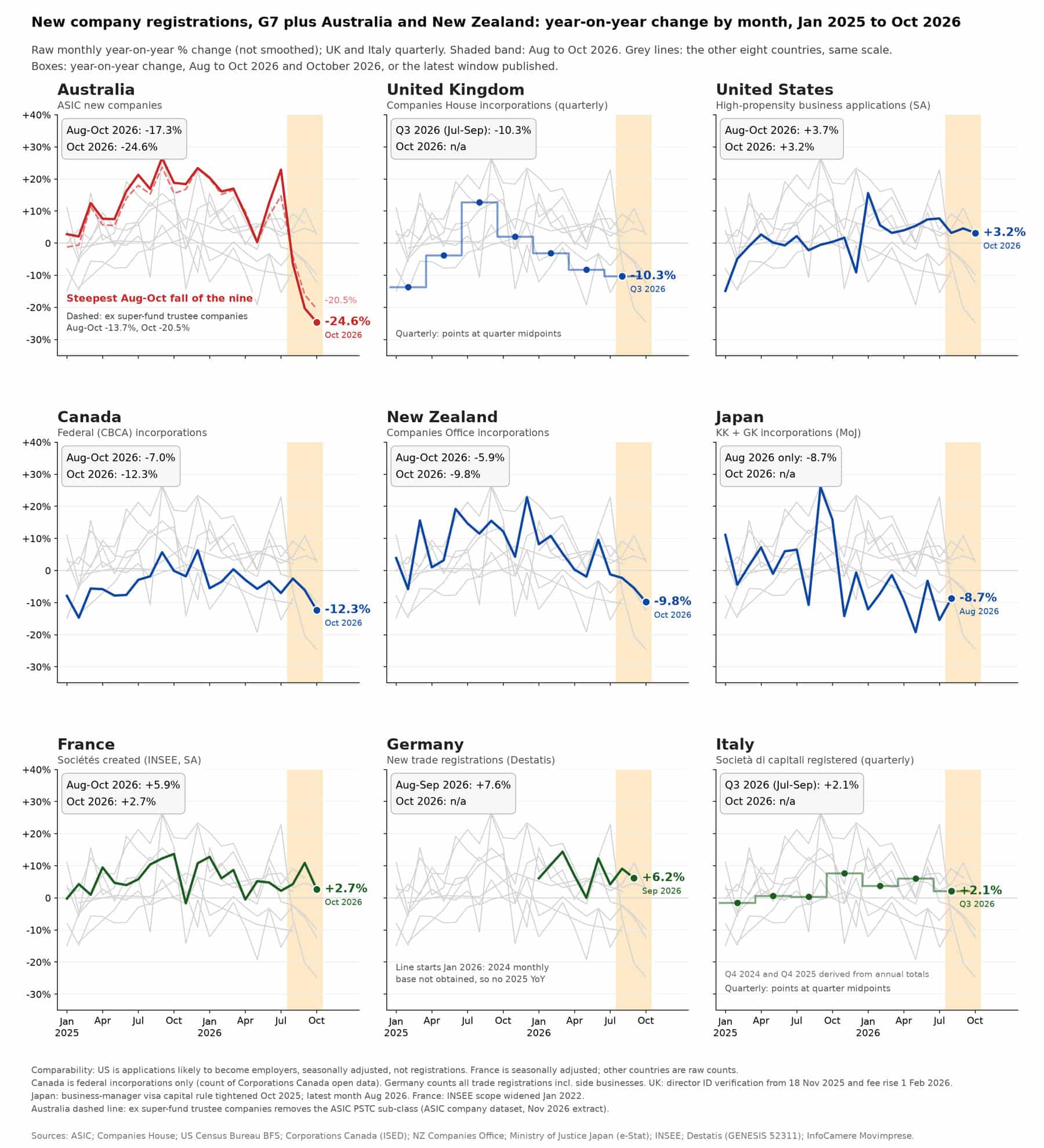
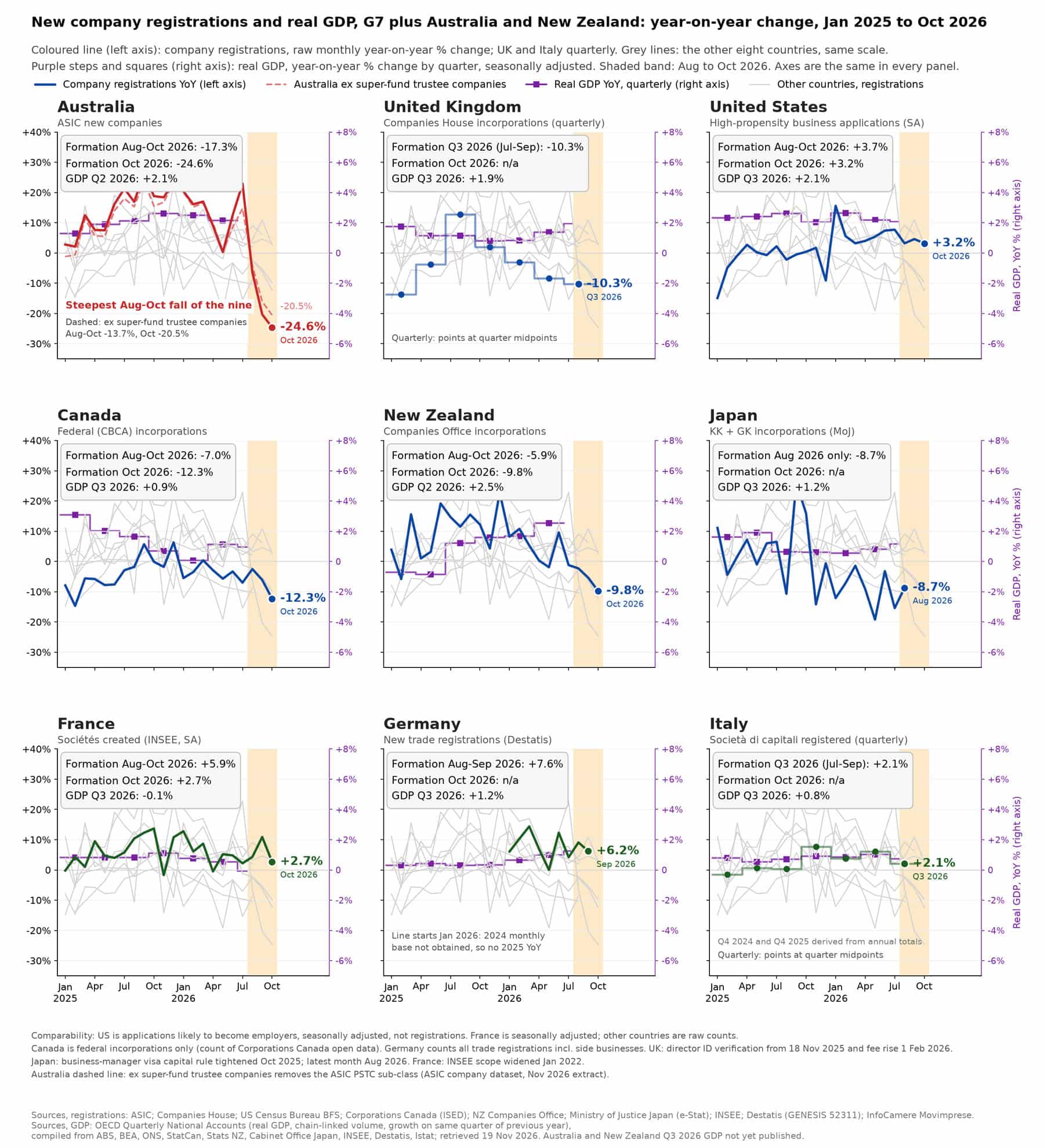
New company registrations in Australia fell 17.3% from August to October 2026 against the same months a year earlier, the steepest fall of the 12 OECD countries that have published figures for those months. October alone was down 24.6%. Excluding super fund trustee companies, August to October was still down 13.7%, which is still the weakest of the 12. The cooling comes off a record high, with 364,748 new companies registered in 2025, the biggest year on record, 21% above 2021 and ahead of every G7 country and New Zealand on five-year growth.
What we found
Behind the October headline, the year is still ahead. The first 10 months of 2026 delivered 320,865 registrations against 308,607 a year earlier, up 4.0%, and up 3.7% once trustee companies are set aside (278,365 against 268,519). 2025 was a record year for Australia, with 364,748 new companies registered, 21% above 2021, the strongest growth across the G7 and New Zealand (Lawpath New Business Index analysis of ASIC, Companies House, Census BFS, Corporations Canada, NZ Companies Office, MoJ Japan, INSEE, Destatis and InfoCamere data). The cooling sits in the most recent months. Registrations ran at 80,970 across August to October 2026, down 17.3% on the 97,876 of a year earlier, and October alone delivered 24,730 registrations against 32,805 (ASIC).
Among the 12 OECD countries (of 38) that have published figures for August to October, Australia’s 17.3% fall is the steepest, followed by Canada at 7.0% (federal registrations only) and New Zealand at 5.9%. The United States grew 3.7% and France grew 5.9%. October alone tells the same story, with Australia down 24.6%, Canada 12.3% and New Zealand 9.8%.
How Australia compares, trustee companies and all
About 13% of new Australian companies are super fund trustee companies (the PSTC class in ASIC’s data), and that group swung hard this year. Trustee company registrations jumped 70% in July against July 2025, then fell 39% across August to October.
The picture holds with trustee companies stripped out, with October registrations down 20.5% (22,294 against 28,048) and August to October down 13.7%. The trustee swing sharpens the fall, and the ex-trustee figures confirm a real slowdown underneath it.
When the cooling started
The fall began in August. July registrations grew 22.9% (44,040 against 35,844), and across the September quarter Australia was down just 0.6%, or 1.5% excluding trustee companies. In that quarter, 11 OECD countries fell faster, and the United Kingdom led among countries reporting company registry data at 10.3%, after director identity checks began in November 2025 and registration fees doubled in February 2026.
The economy kept growing while registrations cooled
Australian real GDP grew 2.1% in the year to the June quarter of 2026 (OECD), in line with the United States at 2.2%. The economy expanded through the same months that registrations cooled, so the slowdown points to factors specific to company formation.
Two drivers are being discussed. The first is the mid-year talk of changes to super, trust and capital gains tax rules, which lines up with the July spike and August-to-October fall in trustee company registrations. The second is a shift toward sole trader registrations in our own Lawpath New Business Index. Both are possible explanations under discussion, and the record 2025 base remains part of the story.
What’s happening elsewhere
The fairest comparisons are the countries that set up companies the way Australia does. In the United Kingdom, New Zealand and Canada, a private company limited by shares is its own legal entity, the owners’ liability stops at their shares, and a central registry counts companies separately from sole traders. All three also see some companies set up to hold assets rather than trade, much like Australia’s super fund trustee companies.
New Zealand is the closest match, with the same private company model and family trust trustee companies on the register, just as Australia has super fund trustees. New Zealand registrations fell 9.8% in October, 5.9% across August to October and 3.0% in the September quarter, so it cooled in the same months as Australia, only less sharply. Over five years the gap is wider. New Zealand’s 2025 registrations sat 6% below 2021, while Australia’s sat 21% above it.
The United Kingdom runs the system Australia’s is modelled on, and its registrations fell 10.3% in the September quarter (193,789 against 215,982). Much of that traces to new rules. Companies House began identity checks for directors in November 2025 and lifted its fee in February 2026, which cleared out low-intent and dormant filings. Buy-to-let property companies, which make up about 8% of UK registrations, explain roughly a tenth of the first-half fall. The UK has not published October figures yet. Its 2025 registrations were 8% above 2021.
Canada splits company registration between the federal register and the provinces, and the federal figures we can count fell 12.3% in October and 5.3% in the September quarter. The fall is spread across company types, with holding company registrations edging up. Canada’s federal registrations in 2025 were 9% below 2021.
Set against those three, Australia’s August to October fall is the sharpest, and it comes from the highest base. Further afield, where company structures and counting methods differ more, the picture is mixed. Japan’s registrations fell (down 8.7% in August), concentrated in foreign-founded companies after its business manager visa capital requirement rose from 5 million yen to 30 million yen in October 2025. The United States grew 3.7% across August to October on its high-propensity applications measure, France grew 5.9%, and Germany’s trade registrations grew 6.4% in the September quarter, driven mostly by side businesses.
How we ran the numbers
We compare companies only, because it’s the one count every country here keeps the same way. The UK, New Zealand and the US keep no register of sole traders or ordinary partnerships, so there’s nothing to line them up against. Australia’s ABN register does count them, and we track them every month in the Lawpath New Business Index.
We compared the raw year-on-year change in new registrations for the same period across three windows: the September quarter, August to October, and October alone. Australia’s figures come from ASIC company registration data, with and without the PSTC class, deduplicated by ACN. Other countries come from their official registry or statistics office, including Companies House for the UK, Corporations Canada for federal registrations, the NZ Companies Office, Japan’s Ministry of Justice, Eurostat for 14 EU members, US Census Bureau high-propensity business applications as the American proxy, INSEE for France and Destatis for Germany. GDP figures come from the OECD Quarterly National Accounts.
Three of those measures are worth naming directly. Germany’s figures count all trade registrations, the US figures count business applications as a proxy for completed formations, and Canada’s count covers federal registrations only.
Four caveats deserve plain statement.
- Measures differ between countries. Australia, the UK, New Zealand and Canada count companies only, while Germany counts every new trade registration, including sole traders and side businesses, and the Eurostat figures include sole traders wherever the national register does. Sole trader numbers move for different reasons (Germany’s 2026 rise came almost entirely from side businesses), so those countries can rise or fall for reasons that have little to do with companies.
- Only the US and French series are seasonally adjusted, because those are the series their statistics offices publish, and the rest are raw counts. Comparing the same month a year apart cancels out most seasonal swings, so raw counts compare fairly. Calendar quirks still show up in raw figures, such as an extra working day or a public holiday falling in a different month, and the adjusted US and French figures smooth those out.
- Only 12 OECD countries have published figures for August to October, so the ranking covers published data alone.
- Some Eurostat figures, including those for Ireland, Lithuania and Austria, are estimated or provisional.
These caveats shape how to read the comparison. It ranks direction and scale across countries whose registries count slightly different things.
What this means if you’re starting a business
Australia is cooling from a record high. The 2025 record, the five-year growth lead and a 2026 year-to-date still running ahead of last year describe a boom easing from its peak, with the recent months asking a genuine question about what comes next. For anyone weighing up a start now, the practical questions stay the same, covering structure, registrations and tax under the rules in force today. Lawpath covers legal, accounting, tax and compliance in one place, and the Lawpath New Business Index tracks these numbers every month.